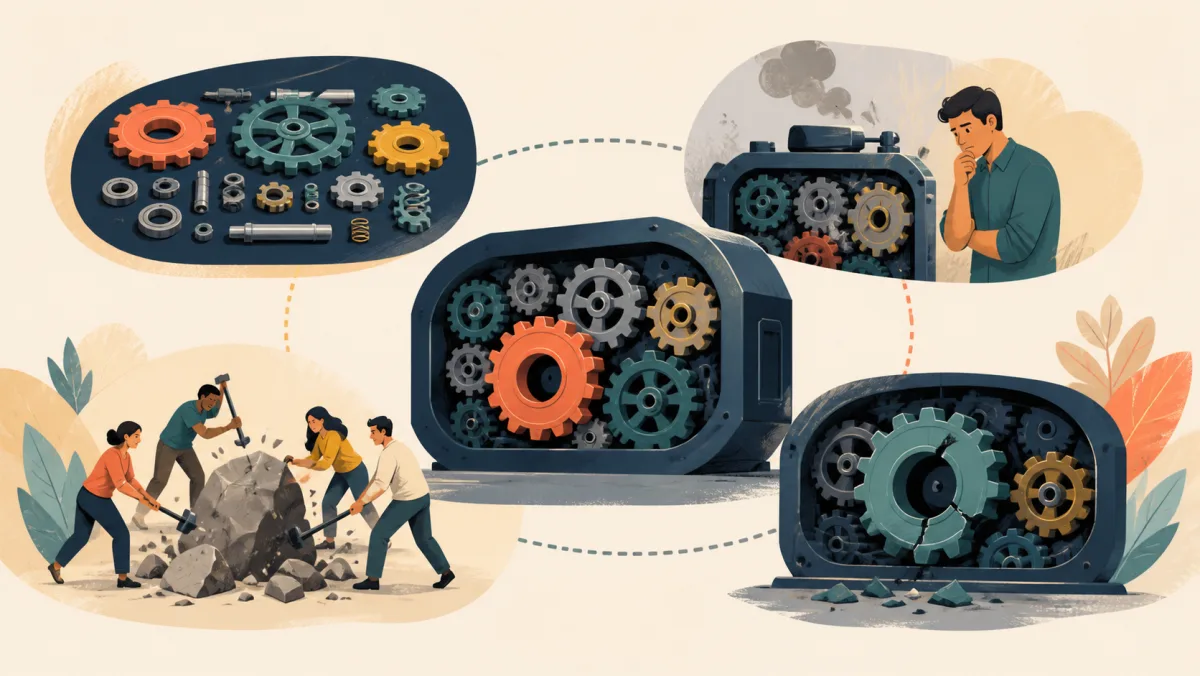
Break down is a simple phrase with four common uses at work: it can mean divide, fail, remove, or stop working. The examples group these uses by meaning and show when the verb takes an object.
Quick check
Choose the sentence that makes the intended meaning clear.
Ready to go beyond the quiz on "Break Down"?
Take the full learning path: hear it in real workplace contexts, watch short explanations, learn its nuances and when to use it, then practice using it yourself.
Start learning for free →Now see if you can use it naturally yourself.
Try it yourself
You know how to use "Break Down," too.
Keep going with the full learning path — more workplace contexts, related expressions, and continued practice.
Continue with "Break Down" →There's more to "Break Down" than it seems.
You've got part of it, but the full learning path goes deeper into its nuances, workplace contexts, and when it sounds natural — then gives you practice using it yourself.
Learn "Break Down" in depth →Decompose: turning a whole into inspectable parts
Status update: "Can you break the budget down into line items before the review? Right now it's just one number."
Report line: "Costs are broken down by region in the appendix."
Process/negotiation collapse: a cooperative process stops working
Postmortem note: "The vendor talks broke down over pricing -- neither side would move on the minimum commitment."
Stakeholder update: "Communication between the two teams broke down somewhere around week three, and that's when the timeline started slipping."
Want to actually use "Break Down" naturally at work?
Understanding it is one thing. Practice its nuances, see how it works in real workplace situations, and use it yourself with feedback.
Start the "Break Down" learning path →Dismantle obstacle: actively removing a structural barrier
Leadership note: "We need to break down the silos between product and support if we want faster escalation paths."
Change initiative: "Part of this reorg is about breaking down the approval bottlenecks that slow every launch down."
Mechanical/systemic failure: equipment or a system stops working
Ops update: "Our CI pipeline keeps breaking down under load whenever we run the full test suite."
Incident note: "The printer broke down again -- can someone put in a ticket?"
The noun form: "a breakdown"
Finance request: "Can you send me a breakdown of costs by department before Friday?"
Retro comment: "There's been a breakdown in trust between the two teams, and that's worth naming directly."
What these examples have in common
Within the four uses above, the object often helps you find the meaning. "Break down [something]" has an object, such as a budget or barrier, and means to divide or remove that thing. "[Something] broke down" has no object after the verb, so it means that the thing stopped working. Thus, "the negotiators broke down the deal's costs" means they divided those costs into parts, but "the deal broke down" means it failed.
There is one more sense to know. "Break down" can describe a person who loses emotional control, as in "she broke down in tears." You may see that use at work. This guide focuses on the four business uses above.
Practice scenarios
Practice using break down in situations like:
- turning an opaque budget or report into itemized parts
- reporting that a deal or negotiation stalled, without assigning blame
- describing active work to remove a structural barrier between teams
- reporting equipment or system failure in an ops update
Useful practice phrases:
- "Can you break the budget down into line items?"
- "The vendor talks broke down over pricing."
- "We need to break down the silos between product and support."
- "Our CI pipeline keeps breaking down under load."
Try it yourself
One phrase can do four jobs. Look for an object and read the context.
Lyra Practice helps advanced non-native English professionals learn the nuance of high-value workplace expressions and practice using them in realistic scenarios, so their English sounds natural, precise, and senior at work. Try Lyra Practice.