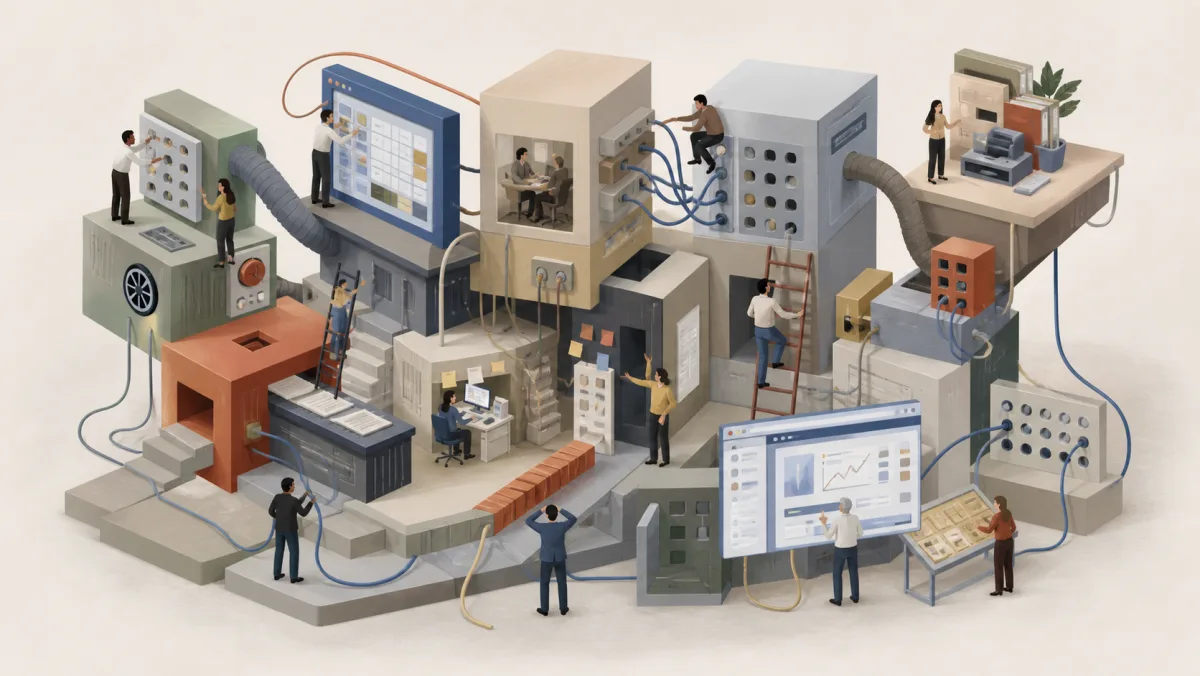
A Frankenstein system or Frankenstein project joins mismatched parts that work poorly together. At work, the label may describe software, files, work steps, or products. Its parts often come from many teams or times.
“After five acquisitions, the billing platform became a Frankenstein system.”
The speaker likely means the platform is patched together and hard to maintain.
Frankenstein is the creator’s name
The story comes from Mary Shelley's 1818 novel Frankenstein; or, The Modern Prometheus. Victor Frankenstein creates the creature but is not the creature. The novel does not give that being the name Frankenstein.
In popular culture, people often call the creature Frankenstein, and many listeners understand that meaning. Still, the difference matters when names need to be exact.
You can call the created being Frankenstein's creature or Frankenstein's monster. However, a Frankenstein system is a familiar workplace label, so a naming lesson may distract from the real work problem.
What does the metaphor highlight?
The image often focuses on how mismatched parts were joined:
- components built for different purposes;
- inconsistent interfaces or styles;
- visible seams and repeated patches;
- unclear ownership;
- behavior that the creators struggle to control.
Not every system built in parts is a Frankenstein. Teams can combine parts by design. The label turns negative when the result is weak or hard to manage.
The label can also suggest results that the creator did not intend. That meaning is stronger than simply calling a system old.
A lot to take in? It is.
But Rome wasn't built in a day. Build your American workplace English one expression and cultural reference at a time—with curated explanations and structured practice in Lyra Practice.
Start a session →What might you hear at work?
“This deck is a Frankenstein of slides from six teams.”
The deck may have mixed styles, repeated claims, or no clear story.
“We built a Frankenstein workflow out of email, spreadsheets, and three ticketing tools.”
The speaker objects to the combined process, not each tool by itself.
“Let’s not create a Frankenstein solution just to meet Friday's demo.”
This warns that rushed work may cost more to maintain later.
“The prototype looks rough, but it isn’t necessarily bad architecture.”
Someone is resisting a strong label until the team reviews the design.
What can you say naturally?
To clarify:
“When you call it Frankenstein, do you mean inconsistent components or unsafe behavior?”
To make the critique actionable:
“The system combines four authentication paths with no shared ownership. Could we consolidate them?”
To hedge:
“The current workflow risks becoming a Frankenstein of one-off exceptions.”
To respond if the reference is unfamiliar:
“Do you mean it was assembled from pieces that were not designed to work together?”
A plain explanation is often clearer for a global team.
Recognition before production
When Frankenstein describes work, look for a negative image of joined parts. The speaker probably is not discussing the novel or its characters.
When using it, name the clear seams. These may include incompatible data, repeated approvals, mixed styles, or unclear ownership. Without details, the label can hide the real problem.
Knowledge of the story varies. Coworkers may know films or translated versions instead of Shelley's novel. Do not use the naming fact to judge what someone knows.
Tone, hierarchy, and security
Calling someone's work a monster can sound insulting. “Who built this Frankenstein?” may embarrass a team and hide past constraints.
Focus on the work and the conditions that shaped it:
“This has accumulated incompatible parts across several migrations.”
This wording allows that earlier teams made sound choices under past limits.
In general security discussion, Frankenstein is not one standard threat category. Name the real risk, such as an unsupported dependency or unclear data flow. Do not confuse it with a Trojan horse, which suggests hidden harm inside something that seems safe.
This image also draws on ideas about bodies and monsters. Never apply it to a person's body, disability, appearance, accent, or identity. Keep it focused on an object or system.
For a reference about one critical weakness, see Achilles’ heel. For a project that releases many secondary problems, see Pandora’s box.
The practical takeaway
A Frankenstein project or system joins mismatched parts in a troubling way. Frankenstein is the creator's surname; the creature has no personal name. At work, replace the metaphor with a specific, useful diagnosis.