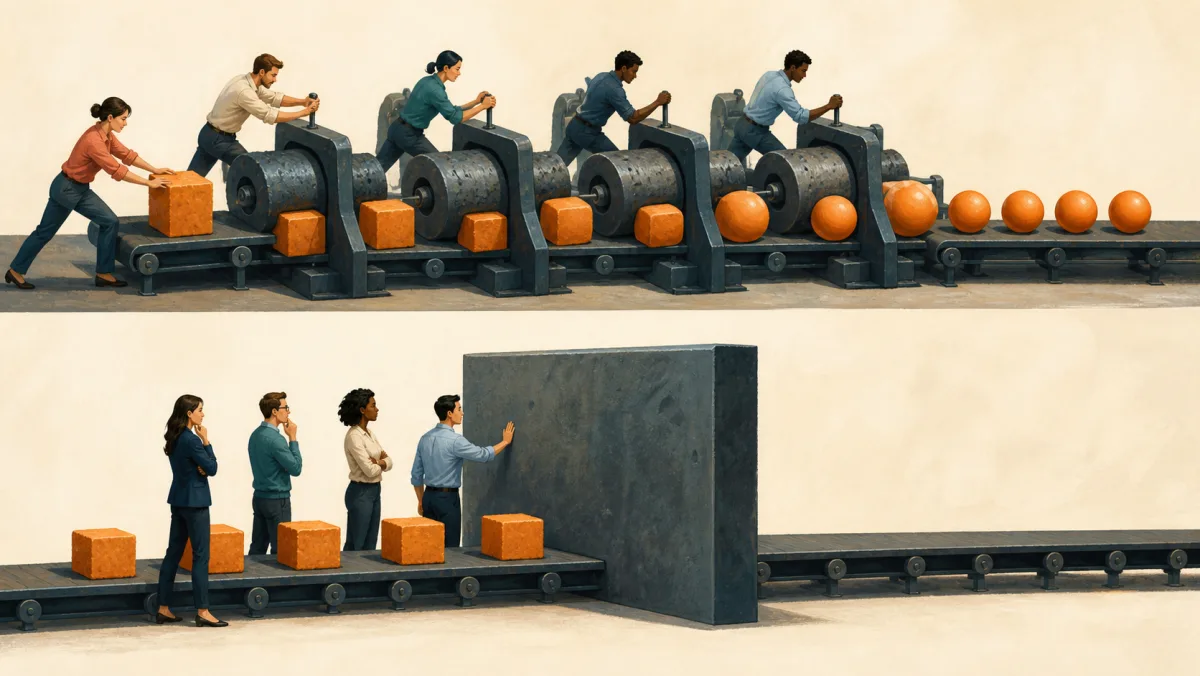
Friction makes a process harder, slower, or less pleasant. A barrier blocks access or progress, though it may stop one route without stopping all work.
A license blocks one national market
Name the effect and its scope from the same expansion facts.
Ready to go beyond the quiz on "Friction"?
Take the full learning path: hear it in real workplace contexts, watch short explanations, learn its nuances and when to use it, then practice using it yourself.
Start learning for free →Now see if you can use it naturally yourself.
Try it yourself
You know how to use "Friction," too.
Keep going with the full learning path — more workplace contexts, related expressions, and continued practice.
Continue with "Friction" →There's more to "Friction" than it seems.
You've got part of it, but the full learning path goes deeper into its nuances, workplace contexts, and when it sounds natural — then gives you practice using it yourself.
Learn "Friction" in depth →The test: does the process still complete?
Ask what the problem does: friction usually adds effort or delay rather than blocking progress by itself. A barrier blocks a person, step, route, or goal without always stopping every part of the work.
Friction: "The reimbursement form now requires a manager's digital signature instead of a scanned one -- a little more friction each month, but reimbursements still go out on schedule."
Barrier: "The company can't launch in that market at all until it obtains a specific regulatory license -- nothing proceeds, sales included, until that license is granted."
Barrier vs its more everyday sibling, obstacle
Barrier and obstacle both name something that gets in the way. A barrier often sounds more formal or built into a system than its more general sibling, "obstacle". Common phrases include a regulatory barrier, a language barrier, and an entry barrier, while an obstacle may be a one-time problem. In both cases, ask what is blocked and do not claim that all work has stopped unless the facts show that.
"The launch checklist has plenty of ordinary friction in it, but none of it mattered until the license came through -- that license was the real barrier, not the checklist."
Want to actually use "Friction" naturally at work?
Understanding it is one thing. Practice its nuances, see how it works in real workplace situations, and use it yourself with feedback.
Start the "Friction" learning path →Why the mix-up matters
Calling a barrier ordinary friction can hide who or what is blocked, making a key need sound like a small delay. Calling routine friction a barrier can overstate the effect and cause an urgent response when a small process fix would work.
"Barrier" often points to a firm or built-in limit, so the fix may be a license, approval, policy change, or new route. Friction may need a simpler form, clearer guide, or faster handoff. First name the effect, then choose the fix. This is a useful "scope check."
A quick way to check which word fits
Use two checks: ask whether the issue adds effort or blocks access, then name the exact step, route, or group it affects. An extra form field may add friction, while a rule that bars a firm from a market is a barrier to entry. The firm may still work on other tasks or choose another market. These words describe the issue and its scope; they do not prove the final outcome.
Practice scenarios
Practice using friction in cases like:
- deciding whether a scenario describes ongoing friction or a genuine hard-stop barrier
- recognizing when a barrier is structural or regulatory rather than just an unusually large piece of friction
- writing a status update that names a true blocking barrier distinctly from routine process friction
Useful practice phrases:
- "This is friction, not a barrier -- the work is still moving, just more slowly."
- "Nothing can proceed until the license comes through -- that's a real barrier."
- "Once that regulatory barrier is cleared, what's left is just ordinary friction in the paperwork."
Keep an accessible route separate from paperwork drag
Friction adds effort or delay, while a barrier blocks access or progress. State the scope before you state the result.
Lyra Practice helps advanced non-native English professionals learn the nuance of high-value workplace expressions and practice using them in realistic scenarios, so their English sounds natural, precise, and senior at work. Try Lyra Practice.