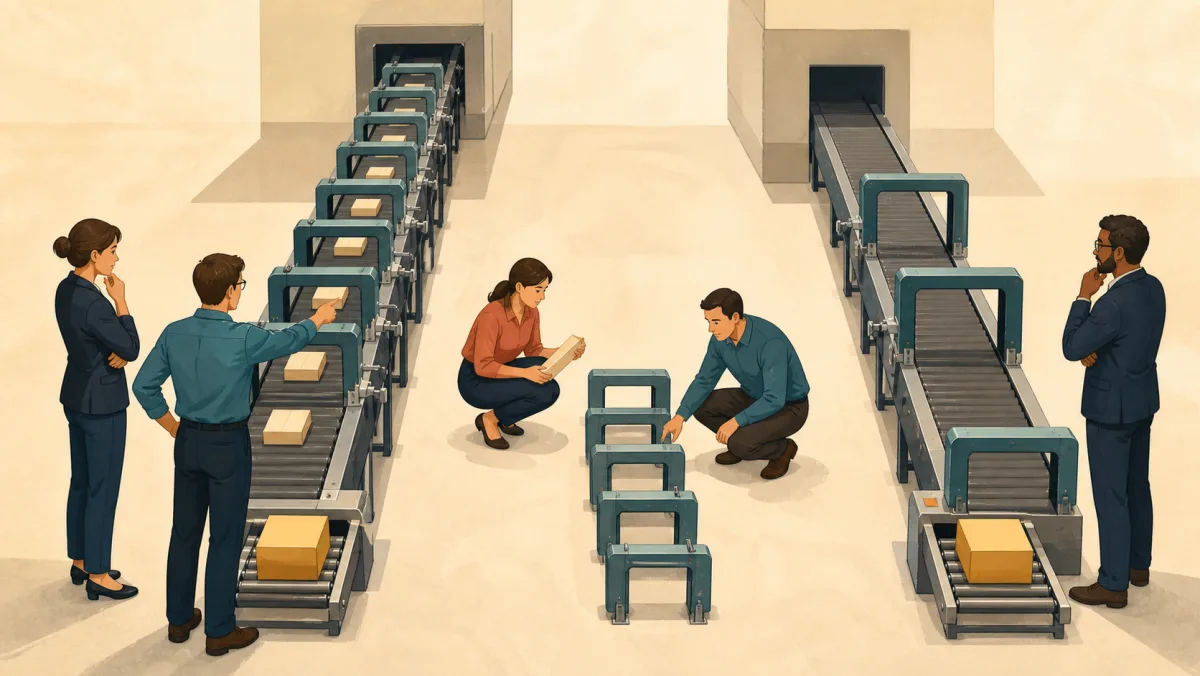
"The streamlined onboarding flow guarantees faster activation."
This sentence promises an outcome. The word "streamlined" does not prove that users will activate faster. That gap creates risk in client-facing writing.
Name the actual change instead: fewer steps, fewer fields, or one click instead of three. Keep that design fact separate from a result such as higher conversion. Use measured evidence and proper context for a result claim. Do not turn it into a guarantee unless the evidence and terms truly support one.
Streamline extends naturally to products and external claims
Streamline fits interfaces, checkout flows, onboarding, and user journeys. It means removing needless steps, delay, effort, or complexity. The word works in both internal and external product writing.
Where the risk comes in
An outside reader may have less context than the product team. A bare "streamlined" claim can therefore sound like unsupported hype. Tell the reader what changed and avoid implying results you have not shown.
Hype, unsupported: "Our new checkout is streamlined for a better experience." (no detail, no evidence)
The sentence gives no detail that a reader can check. "Better experience" is also broad and subjective. The claim sounds positive but says little.
Want to get better at distinctions like this?
Lyra Practice helps you learn the nuance of high-value workplace expressions, then practice using them in realistic situations.
See how Lyra Practice works →The fix: name the mechanism, not just the promise
Credible, specific: "Our new checkout is streamlined: three fields instead of seven, and no account creation required." (concrete, verifiable)
A reader can picture and check this change. The statement does not prove that checkout will be faster for every user. It does explain why the team calls the flow streamlined.
Overclaiming: "The streamlined onboarding flow guarantees faster activation." Better: "The streamlined onboarding flow -- three fewer setup steps -- is designed to help new users activate faster." (claim matches what's actually been shown)
"Is designed to help" states an aim, not a measured result. The sentence also names three fewer setup steps. Automation, consolidation, and fewer fields describe mechanisms. Faster use, lower cost, and higher conversion are outcomes. Test those outcomes before claiming them, and state the method, group, and time frame when relevant.
The mistake to avoid
Do not let "streamlined" stand in for a business result. A shorter flow may help, but it can also create new issues. Name the concrete change first. Then report any measured result as a separate claim, with its limits. Product, legal, and marketing review may also apply to public claims.
Practice scenarios
Practice writing credible, specific client-facing product updates using streamlined, in situations like:
- writing release notes for a shortened checkout flow
- describing a new onboarding experience to a prospect without promising a metric you haven't measured
- catching a draft that upgrades "designed to help" into "guarantees"
Useful practice phrases:
- "Our [product/flow] is streamlined: [specific, countable detail]."
- "This is designed to help with [outcome]" instead of "this guarantees [outcome]."
- "That claim promises a result we haven't actually shown -- let's name the mechanism instead."
A streamlined product deserves a specific claim.
Name the fields, clicks, or steps. Then let clear evidence support any result.
Lyra Practice helps advanced non-native English professionals learn the nuance of high-value workplace expressions and practice using them in realistic scenarios, so their English sounds natural, precise, and senior at work. Try Lyra Practice.