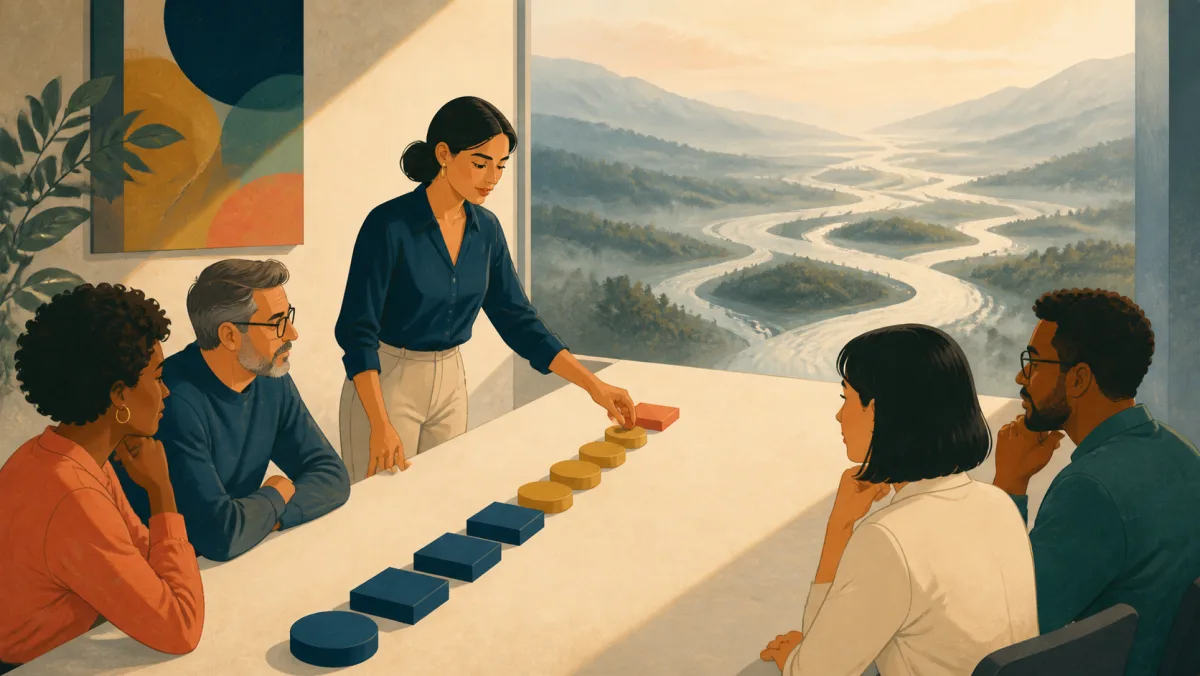
"Lay out", "play out", and "pan out" sound alike, yet each phrase has a distinct purpose in professional communication.
You can "lay out" a plan or set of choices for a clear presentation. Events "play out" as they develop over time. A plan "pans out" if it produces the intended result. These phrases can refer to any time, not just now or later.
Quick check: unfolding or outcome?
The facts stay the same; choose the emphasis they support.
Ready to go beyond the quiz on "Lay Out"?
Take the full learning path: hear it in real workplace contexts, watch short explanations, learn its nuances and when to use it, then practice using it yourself.
Start learning for free →Now see if you can use it naturally yourself.
Try it yourself
You know how to use "Lay Out," too.
Keep going with the full learning path — more workplace contexts, related expressions, and continued practice.
Continue with "Lay Out" →There's more to "Lay Out" than it seems.
You've got part of it, but the full learning path goes deeper into its nuances, workplace contexts, and when it sounds natural — then gives you practice using it yourself.
Learn "Lay Out" in depth →Lay out: a deliberate act, now
"We laid out the plan for the quarter at Monday's all-hands."
Here, the team deliberately presented the plan in a clear order. The phrase can also mean to arrange physical objects. Despite this section's heading, you can lay something out in any tense.
Play out / pan out: an unfolding, later
"We'll see how this plays out over the next few months."
Here, the situation will develop over time. People may still influence it, but the final outcome is not yet clear. If a plan "pans out," it produces the intended result; if it does not pan out, it fails to produce the hoped-for result.
Want to actually use "Lay Out" naturally at work?
Understanding it is one thing. Practice its nuances, see how it works in real workplace situations, and use it yourself with feedback.
Start the "Lay Out" learning path →The confusion point
The phrases can appear together: "we'll lay out the options" and "we'll see how it plays out." The first names an intentional presentation of choices. The second asks how events will evolve. It does not imply complete passivity.
The rule
Use "lay out" when someone presents or arranges something. Use "play out" for events that unfold over time. Use "pan out" for the result, often when asking if a plan worked. Context matters, since each phrase also has other meanings.
Practice scenarios
Practice choosing between lay out and play out/pan out in situations like:
- promising to present a plan clearly at a specific moment
- describing an uncertain situation that's still developing
- distinguishing a deliberate presentation from events that unfold over time
Useful practice phrases:
- "We laid out the plan for the quarter at Monday's all-hands."
- "We'll see how this plays out over the next few months."
- "Let's lay out the options first, then see how the negotiation plays out."
Present the options
Lay out concerns presentation or arrangement, play out concerns events over time, and pan out concerns the eventual result.
Lyra Practice helps advanced non-native English professionals learn the nuance of high-value workplace expressions and practice using them in realistic scenarios, so their English sounds natural, precise, and senior at work. Try Lyra Practice.