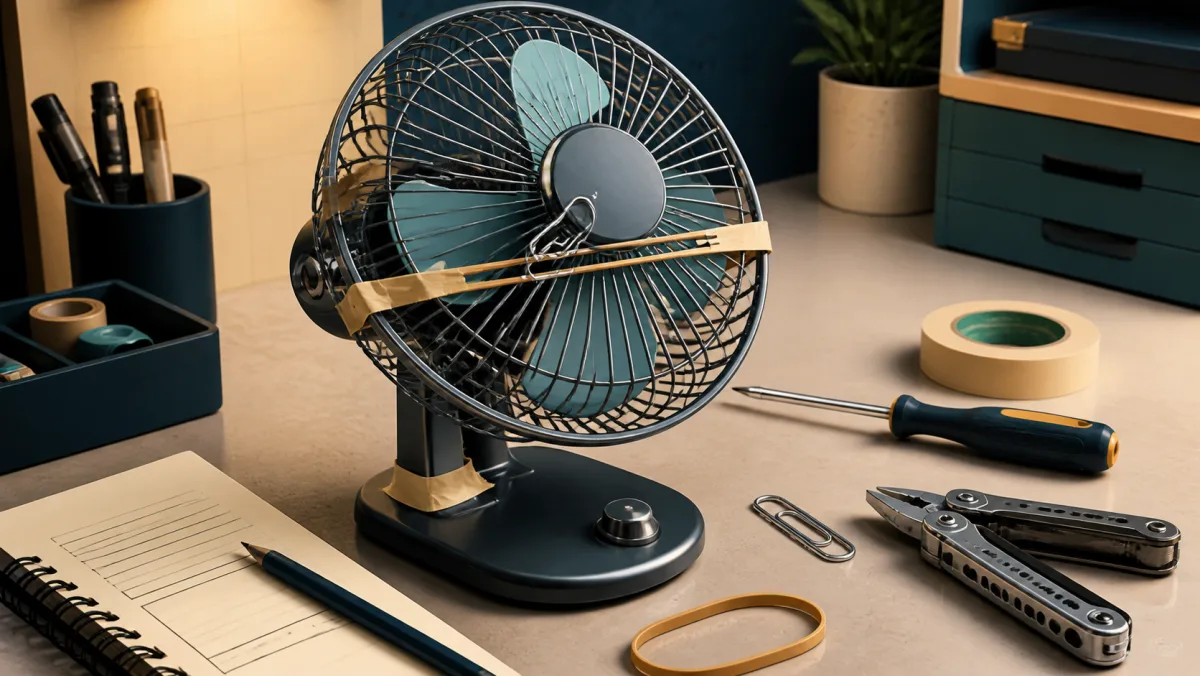
To MacGyver something is to improvise a workable solution from the tools or materials available.
The examples below show the expression in realistic workplace contexts. They also show the grammar around it, not only the definition.
Want to get better at distinctions like this?
Lyra Practice helps you learn the nuance of high-value workplace expressions, then practice using them in realistic situations.
See how Lyra Practice works →Natural examples
Example 1
“We MacGyvered a tablet stand from a spare bracket for the demo.”
Example 2
“The event team MacGyvered a temporary check-in desk from two tables.”
Example 3
“We can MacGyver something together for today, then install the standard unit tomorrow.”
Example 4
“We MacGyvered a badge holder from a binder clip and spare lanyard.”
Example 5
“The team MacGyvered a temporary display stand from spare shelving.”
Example 6
“We MacGyvered a cable guide out of two clips and a sleeve.”
Example 7
“We MacGyvered a temporary latch from a paper clip.”
Example 8
“They MacGyvered a microphone holder from the spare stand, tape, and clamp.”
Example 9
“We MacGyvered a temporary lectern out of two storage bins.”
Example 10
“We MacGyvered a tablet stand from a spare bracket so the demo can run this afternoon.”
More ways to build the sentence
These are the main patterns to practice:
MacGyver + objectMacGyver + object + from + materialsMacGyver + object + out of + materialsMacGyver + object + with + available itemMacGyver a temporary + nounMacGyver something together
Use the pattern that matches your message. Do not force the expression into every sentence. A direct description is often better when the stakes are high or the audience may not know the phrase.
What the sentence needs to make clear
A strong sentence gives enough context for the listener to understand why the expression fits. Name the plan, behavior, decision, or result you mean. If the phrase contains criticism, connect it to observable facts rather than using it as a label.
Compare these nearby choices:
| Choice | What it adds |
|---|---|
| fix | restore function; it does not necessarily imply improvisation. |
| patch | make a limited repair or software change; it may use a standard method. |
| engineer | design deliberately, often with analysis and testing. |
| assemble | put parts together without necessarily suggesting unusual resourcefulness. |
These terms may describe the same situation from different angles. Choose the one that matches the point you need to make.
Tone and audience
Informal and conversational; both MacGyver and lowercase macgyver appear in use. Precise records usually name the actual temporary action instead.
Before using the expression, ask three questions:
- Does the sentence match the expression's real meaning?
- Is the tone suitable for this person and setting?
- Would a plain description be clearer or fairer?
Practice it aloud
Start with one of the common patterns. Add a real but non-confidential workplace situation. Then say the sentence once in a direct version and once in a softer version. This helps you control both meaning and tone.
The goal is not to memorize one example. It is to build a sentence that makes the meaning, evidence, and tone clear.
Lyra Practice helps advanced non-native English professionals learn the nuance of high-value workplace expressions and practice using them in realistic scenarios, so their English sounds natural, precise, and senior at work. Try Lyra Practice.