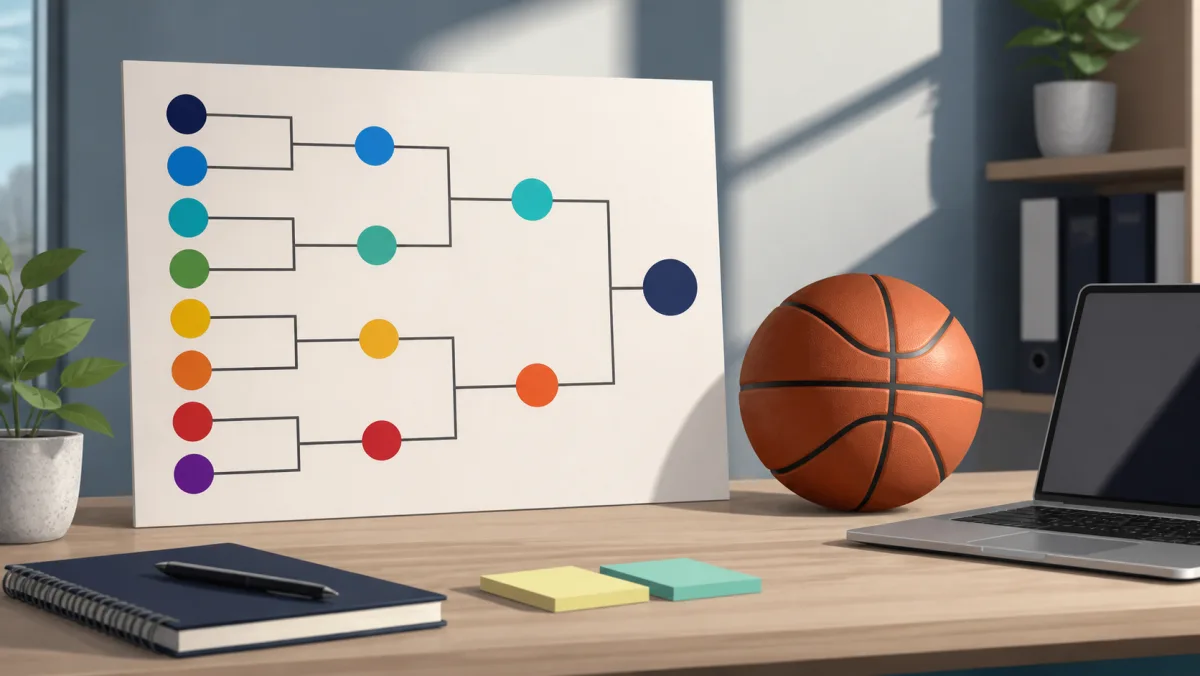
A March Madness bracket records predictions for major U.S. college basketball tournaments. The games begin in March and usually end in early April. Coworkers may compare brackets and discuss surprising wins. You predict each winner and the teams that advance.
Workplace interest varies. Some offices run a pool, while others only discuss the games. Some pools are free. If money is involved, company rules and local law may apply. A coworker-run pool is not always an official company event.
What is March Madness?
March Madness is a popular name for the NCAA Division I men's and women's tournaments. Both use single-elimination games. A losing team is out, while the winner moves on.
A bracket is the chart that connects each matchup to the next round. Before play begins, a person chooses each winner and the final champion.
You might hear:
"Have you filled out your bracket yet?"
"My bracket is already busted."
A busted bracket has several failed picks, often after an expected winner loses early.
"That upset ruined everyone's Final Four picks."
An upset occurs when a less-favored team beats an expected winner. The Final Four are the last four teams in each tournament.
Seeds, picks, and Cinderella teams
Teams receive seeds, or rankings within each region. A lower number usually means a stronger team. If a twelve seed beats a five seed, the result is an upset.
A less-favored team that goes far may be called a Cinderella team. The reference suggests an unexpected rise. People also use Cinderella story for other surprising success, though the label may hide a more complex story.
Other useful terms include:
- pick: your prediction for a game
- champion: the team you predict or that ultimately wins the tournament
- Sweet Sixteen: the sixteen teams still playing at that stage
- Elite Eight: the eight remaining teams in the next stage
- office pool: a group competition that compares participants' predictions
Pool scoring varies. Later rounds often earn more points, so check the rules.
A lot to take in? It is.
But Rome wasn't built in a day. Build your American workplace English one expression and cultural reference at a time—with curated explanations and structured practice in Lyra Practice.
Start a session →What you might hear at work
Some comments refer to the games:
"I picked UConn to win the tournament."
"Did you see the game last night?"
Others borrow bracket language:
"We made a bracket for the product-name finalists."
Here, coworkers use head-to-head rounds to compare options.
"Marketing is running a snack bracket in Slack."
This is probably a low-stakes poll with several rounds. Teams may create similar brackets for movies, food, mascots, or ideas.
What you could say if you do not follow basketball
You can join without pretending to know the teams:
"I don't follow college basketball closely. Which team is the big surprise this year?"
"I filled out a bracket based on team colors, so my strategy may not survive the first round."
"What does it mean when you say your bracket is busted?"
If you prefer not to participate:
"I'll skip the pool, but I'm curious to see who everyone picked."
These responses are friendly without making sports knowledge a workplace requirement.
Money, pressure, and workplace boundaries
Some pools have no fee and offer only recognition or a small prize. Others ask each person for money. Gambling rules depend on company policy and location. This article is not legal or HR advice. Ask how the pool works before joining.
You could ask:
"Is this just for fun, or is there an entry fee?"
"Is the bracket an official company activity or an informal coworker pool?"
Riskier:
"Everyone has to put in twenty dollars."
That can pressure people with financial, faith, legal, or personal reasons not to join.
Safer:
"The free bracket is open to anyone who wants to join. No basketball knowledge required."
If the whole team is invited, remote staff should get the same basic details. An online bracket can include different locations, though time zones and interest may vary.
Is March Madness a major workplace topic?
The event is highly visible in some U.S. workplaces and absent in others. Interest varies by region, school ties, team, field, and year. Do not assume every American likes basketball or supports a former school.
A natural conversation starter is:
"Does your team do anything for March Madness?"
This asks about local habits instead of assuming them.
Four ideas cover much of the talk: a bracket records picks, and an upset defeats expectations. A busted bracket has failed picks, while a Cinderella team advances farther than expected.
For another U.S. sport explained through workplace conversation, see American football rules for non-Americans. To understand a related hindsight metaphor, read what “Monday-morning quarterback” means.