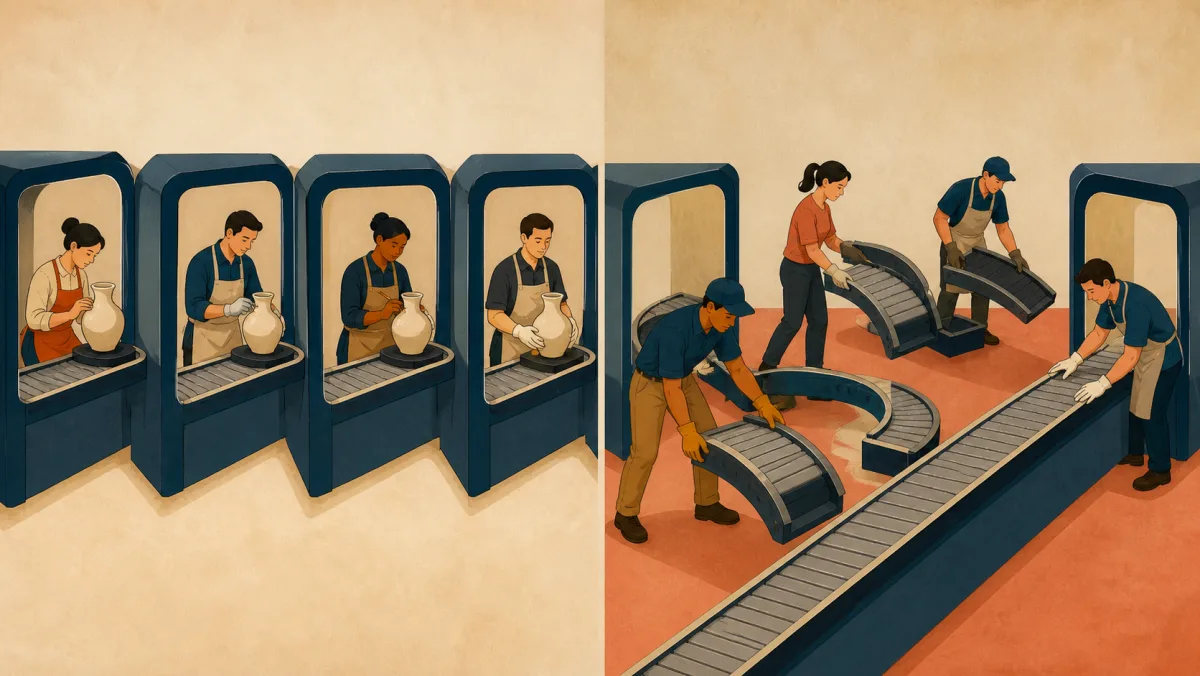
Seamless and streamlined both describe a better process, but they name two different kinds of improvement.
"Streamlined" means a process has fewer or simpler steps. "Seamless" means separate parts connect without feeling separate, so it describes a join rather than the step count. Ask whether the work crossed a boundary or one process simply got shorter.
Four approvals removed, no boundary crossed
Choose the word that identifies the improvement in the same procurement workflow.
Ready to go beyond the quiz on "Seamless"?
Take the full learning path: hear it in real workplace contexts, watch short explanations, learn its nuances and when to use it, then practice using it yourself.
Start learning for free →Now see if you can use it naturally yourself.
Try it yourself
You know how to use "Seamless," too.
Keep going with the full learning path — more workplace contexts, related expressions, and continued practice.
Continue with "Seamless" →There's more to "Seamless" than it seems.
You've got part of it, but the full learning path goes deeper into its nuances, workplace contexts, and when it sounds natural — then gives you practice using it yourself.
Learn "Seamless" in depth →Fewer steps, or a crossed boundary?
"A purchasing team cut six approval sign-offs to two. The workflow stays in the same system. That's streamlined, not seamless. No boundary is crossed. One process just has fewer steps."
Six sign-offs became two, which is a real improvement within one system. No separate parts connect; the process itself just has less friction. "Streamlined" names that change well.
"A reorg gives an employee a new manager. The old and new managers meet first to share context and priorities. This can make the change seamless. The employee crosses a real relationship boundary without losing key details. The process is not just shorter."
This example is not about fewer steps; in fact, the handoff meeting adds one. The change feels seamless because it crosses a real boundary. The employee gets a new manager but keeps the needed context.
Want to actually use "Seamless" naturally at work?
Understanding it is one thing. Practice its nuances, see how it works in real workplace situations, and use it yourself with feedback.
Start the "Seamless" learning path →The common mistake: claiming a crossed boundary that isn't there
Calling a simpler single-system workflow "seamless" suggests a smoother join between systems or teams. Yet no such boundary was crossed, which can make a process audit unclear. The real improvement was fewer steps in one place.
Practice scenarios
Practice choosing between seamless and streamlined in these situations.
- describing a shorter internal workflow with no system or team boundary
- describing a real handoff across a team, system, or relationship boundary
- spotting an audit claim that treats fewer steps as a crossed boundary
Useful practice phrases to try.
- "That's streamlined -- fewer steps, same system, no boundary involved."
- "That's seamless -- an actual boundary got crossed and nobody felt it."
- "Calling that seamless overstates it; it was really just a shorter process."
Describe Leila’s manager handoff
Streamlined looks at steps. Seamless asks whether people felt a boundary.
Ask whether separate parts were joined, and let the answer guide your word choice.
Lyra Practice helps advanced non-native English professionals learn the nuance of high-value workplace expressions and practice using them in realistic scenarios, so their English sounds natural, precise, and senior at work. Try Lyra Practice.