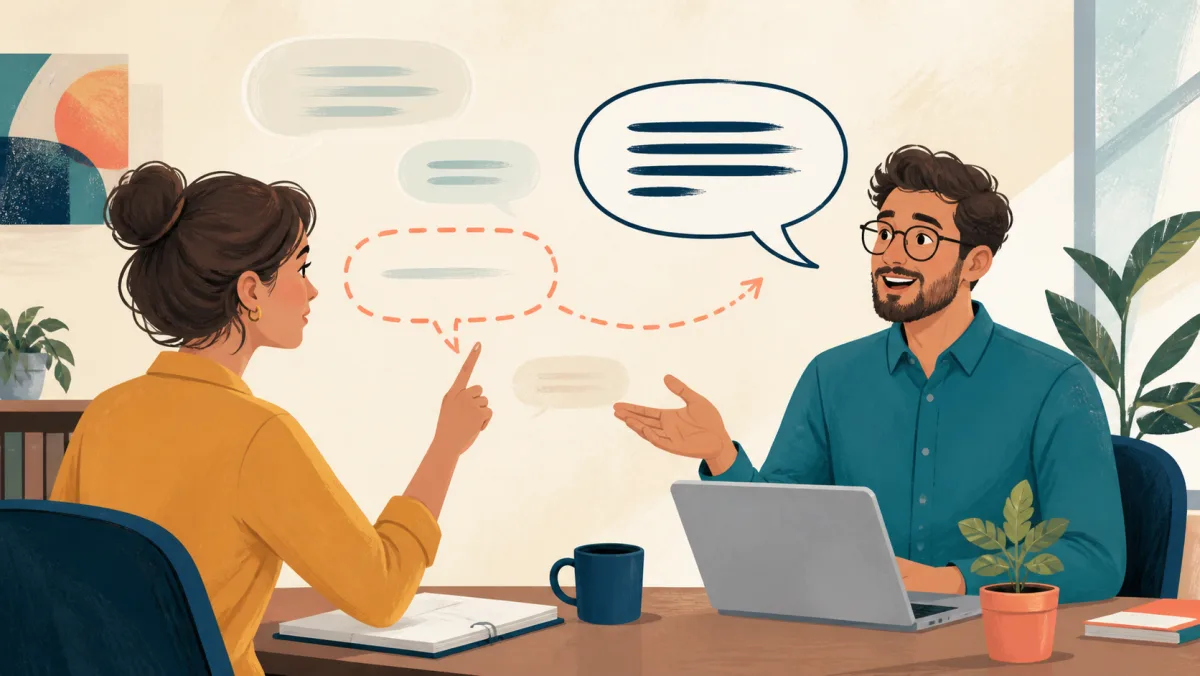
“Sorry, I didn’t catch that” usually means I did not hear or understand what you just said. Here, catch refers to receiving the words or meaning.
The phrase is common and usually polite. A specific follow-up makes it more useful.
Use it for a short listening failure
Natural examples include:
“Sorry, I didn’t catch the last name.”
“I didn’t catch what you said after ‘budget.’”
“Sorry, I didn’t catch that. Could you repeat it?”
Naming the missing part helps the speaker give a focused reply.
“I didn’t hear you” is more literal
Use this when volume, distance, or audio quality is the main issue:
“I couldn’t hear you for a second—the connection dropped.”
“I didn’t hear the final number.”
“I didn’t catch that” can refer to hearing or quick understanding. “I didn’t hear you” points more clearly to sound.
“I didn’t follow” describes the reasoning
If you heard the words but lost the logic, ask for explanation:
“I followed the first two steps, but I didn’t follow how we reached the estimate.”
“I’m not sure I follow. Why would the change reduce support volume?”
Hearing the same sentence again may not fix a gap in logic. Ask for an example, a sequence, or the key assumption.
Understanding is only the first step.
Lyra Practice helps you retrieve and use high-value workplace expressions in realistic situations until they feel natural.
Start a practice session →“I missed that” can have several meanings
“I missed that” may mean you did not hear or notice something. It can also mean you were absent:
“I missed the point about procurement. Could you go back to it?”
“I missed yesterday’s meeting. Was a decision made?”
Because the phrase is broad, name what you missed.
“Could you say that again?” is direct and neutral
This is often the simplest choice:
“Could you say the date again?”
“Could you repeat the recommendation?”
“Say that again” may express surprise or a challenge in a sharp tone. Could you plus a clear object signals a simple request.
Avoid apologizing for too long
You usually need only a brief signal:
“Sorry—what was the deadline?”
A long apology such as “I’m so sorry, English is not my first language and I have trouble understanding” may delay the meeting. State an access or audio need when it matters. A routine request needs no long defense.
Match the phrase to the problem
Use this quick distinction:
- Missed sound: “I didn’t catch the last word.”
- Audio failure: “The audio cut out. Could you repeat that?”
- Unknown term: “What does ‘SLA’ mean in this context?”
- Missing reference: “Which previous launch do you mean?”
- Unclear reasoning: “Could you walk me through that conclusion?”
- Unclear decision: “To confirm, are we approving the change today?”
Respond after the repeat
Close with the relevant meaning:
“Thanks—I have Thursday at noon.”
“Understood. The exception applies only to existing customers.”
This confirms that you now share the same meaning. If doubt remains, ask a narrower question.
Practice the alternatives as decisions
Do not learn these as exact synonyms. First identify the problem. Bad audio needs different language from an unknown acronym. Then say the confirmed meaning aloud.
For a full repair sequence, see How to Ask Someone to Repeat at Work. For exact details, read How to Confirm Names, Numbers, and Dates.
What to say when several people spoke at once
Do not pretend that one person alone was unclear:
“There were two voices at the same time. Could we hear Maya’s point first and then Daniel’s?”
“I missed both comments because of the overlap. Maya, could you repeat yours?”
This treats overlap as a turn-taking problem. If you understood one comment, say which one you missed.
On a call, the meeting lead can summarize: “I heard a concern about cost and another about timing. Let’s take them separately.” This can help the group and prevent more confusion.
The phrase “I didn’t catch that” can begin the repair. Choose the alternative that best names the cause of the gap.