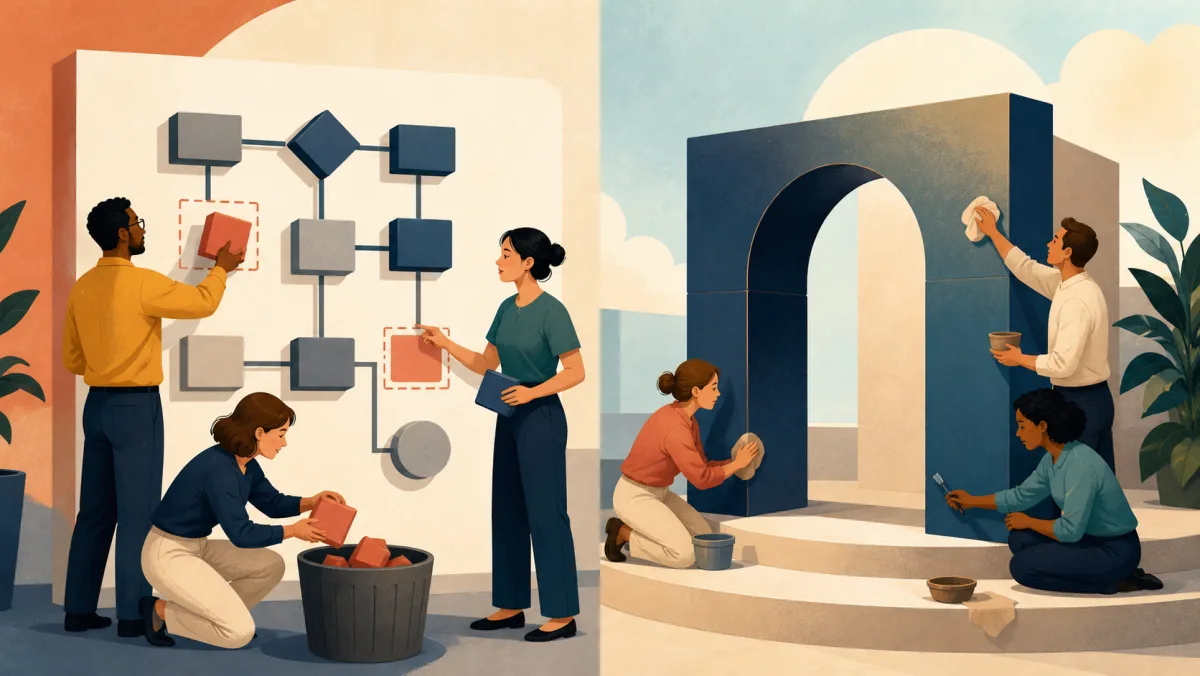
Improve names a "positive change." Streamline is more specific. It usually means making a process or system more "efficient." This often involves removing needless steps, delay, or complexity.
The words can overlap, but they are not fixed synonyms. A team may streamline one part of a process and harm another. For example, fewer review steps may save time but raise risk.
Use "improve" for a broad gain in quality, results, or experience. Use "streamline" for a change meant to make work flow with less waste. State the metric when it matters: time, cost, effort, errors, or handoffs.
Improvement doesn't require a process at all
A better color scheme can improve a product without changing a process. Clearer evidence can improve a proposal in the same way.
"We improved the report's clarity by rewriting the summary section." (a quality change, not a process change)
"We improved the customer story by adding clearer evidence." (a stronger account, with no process claim)
Neither example describes a workflow. Improve is the clearer verb because the change is about quality. In other settings, people do streamline text, designs, or product ranges. There the word means removing excess parts, not redesigning a formal process.
Want to get better at distinctions like this?
Lyra Practice helps you learn the nuance of high-value workplace expressions, then practice using them in realistic situations.
See how Lyra Practice works →Streamlining is one specific kind of improvement
"We streamlined the reporting process by removing one manual export step." (less manual work in the flow)
This is a narrow claim about how work moves. A step is gone, so the team expects less effort or delay. That result should still be checked. A faster process is not healthier if it shifts work to others, blocks access, or weakens a needed control.
The mistake: reaching for "streamline" as a fancier "improve"
Do not choose "streamline" only because it sounds formal. Name the change you made. If you cut handoffs, removed duplicate work, or made a flow easier, the verb may fit. If quality rose in another way, improve or a more exact verb may be better.
A process is a strong clue, but not a strict test. You can streamline a document or product line by removing excess parts. You can also improve a process without streamlining it. Better controls, fairer access, or more staff may improve its health while adding steps.
Practice scenarios
Practice choosing between streamline and improve for the specific kind of change described, in situations like:
- describing a UI or copy change that has nothing to do with a workflow
- reporting a genuine process fix that removed a specific step
- catching a draft that reaches for "streamline" as a fancier word for "better"
Useful practice phrases:
- "That calls for 'improve,' not 'streamline' -- the change affects quality, not efficiency."
- "We streamlined [process] by cutting [specific step] -- that's more specific than just 'better.'"
- "Use 'improve,' not 'streamline,' here -- no flow or excess is being removed."
"Improve" is broad. "Streamline" makes a claim about efficiency or reduced complexity.
Use the narrow word only when that claim is true, and name the result you will measure.
Lyra Practice helps advanced non-native English professionals learn the nuance of high-value workplace expressions and practice using them in realistic scenarios, so their English sounds natural, precise, and senior at work. Try Lyra Practice.