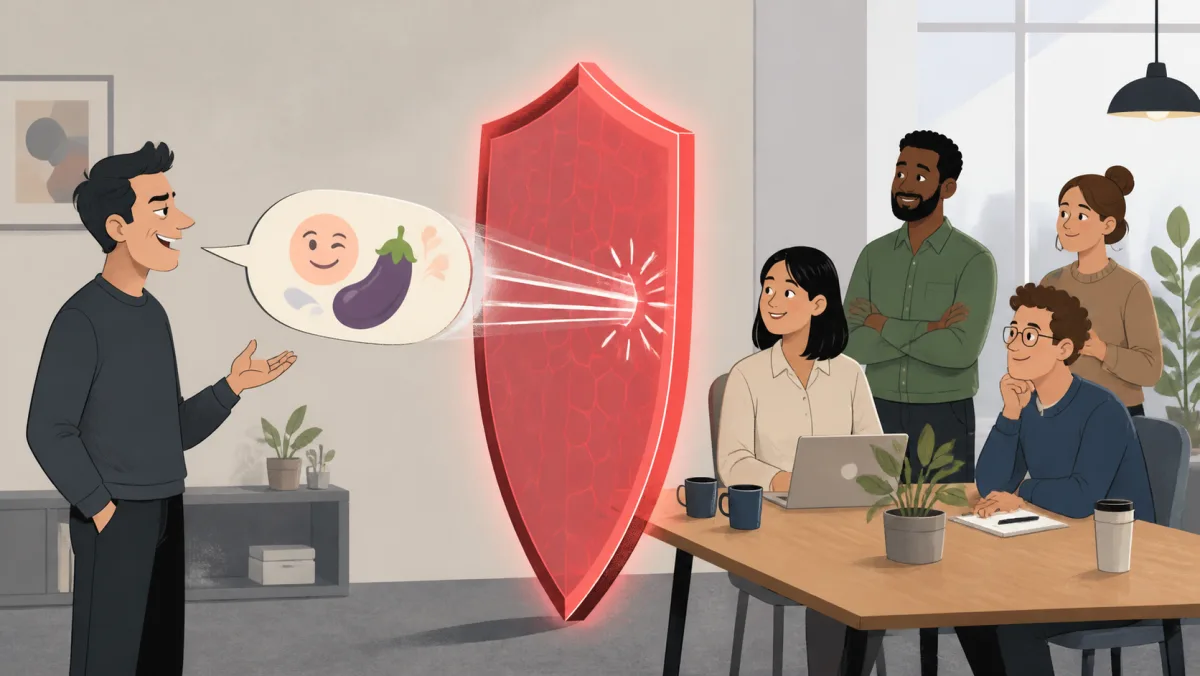
“That's what she said” turns an ordinary comment into sexual innuendo. Many people link it to Michael Scott in the US version of The Office. The joke existed before the series, however.
Someone might say “That was harder than expected” and get this reply. The reply treats the first comment as if it also described sex.
The key is to recognize the shift: the speaker is adding a sexual meaning. You do not need to repeat the line at work.
How does the joke work?
The phrase depends on a double meaning. A sentence is innocent in its first context. A listener then acts as if the same words refer to sex.
Comments about size, length, speed, position, or effort often set up the joke. The reply points out the possible innuendo. It adds no business meaning.
In The Office, manager Michael Scott often uses the line. His poor judgment is part of the comedy. He brings sexual humor into work and ignores social limits. Peacock also notes the line in an episode about a legal deposition.
That context matters. The show presents his conduct as awkward and unprofessional, not as good management.
What might you hear at work?
You may encounter the phrase in:
- informal conversations among colleagues
- messages or meme reactions
- references to The Office
- jokes after an accidentally suggestive sentence
- criticism of someone behaving like Michael Scott
Someone may also stop before saying it:
"I could make a The Office joke here, but I won't."
This signals that the person noticed the double meaning but chose not to make it sexual.
If a colleague mentions “a Michael Scott joke,” they may mean this type of innuendo. “Don't make the obvious joke” can also signal the same concern.
A lot to take in? It is.
But Rome wasn't built in a day. Build your American workplace English one expression and cultural reference at a time—with curated explanations and structured practice in Lyra Practice.
Start a session →Why is it risky at work?
The reply adds sexual content to another person's words. They may not welcome that shift. Intent does not control how the comment affects the room.
Risk increases when:
- a manager says it to a direct report
- the target has already shown discomfort
- the joke is repeated
- the conversation includes clients or customers
- it appears in a recorded or written channel
- people cannot easily leave the situation
- the workplace has clear policies about sexual comments
Team norms vary, but group familiarity is not consent from every person. Laughter may show surprise or social pressure, not comfort.
Policy and legal questions are not identical. A comment can be inappropriate or break company policy without meeting a legal test. Under US federal law, one mild, isolated remark is not automatically unlawful harassment. The full facts, severity, frequency, and state or local law matter. Ask HR, a union representative, or a qualified adviser about a real case.
Recognition is not permission to produce it
Understanding the joke helps you follow the exchange. It does not require you to join in.
If someone uses the phrase, you can simply let the moment pass and return to the topic:
"Anyway, the installation took two hours. What is the next step?"
If you missed the meaning, ask a trusted person in private. This may be easier than asking during the meeting:
"I think I missed a reference earlier. Was that a joke from The Office?"
If the joke targets your words, you can respond at several levels:
"Let's keep this professional."
"I'd rather not turn my comment into a sexual joke."
"Please don't make that joke about what I say."
You do not owe the speaker a smile or a clever answer.
What can you safely say instead?
If you notice a double meaning, you can ignore it. Continue with the intended business point:
"Yes, the review was harder than expected. Which part caused the delay?"
If you want light humor, choose humor that does not sexualize a colleague:
"That sentence sounded more dramatic than I intended."
"Let me rephrase that before it becomes the meeting's headline."
These replies note awkward wording without turning a colleague's comment into sexual material.
What if everyone on the team uses it?
A close group may treat the line as familiar humor. Yet teams change, and a new colleague may have different limits. Written messages can also reach people outside the first audience.
Before repeating it, ask more than “Will people understand it?” Also consider:
- Does it introduce sexual content?
- Is there a power imbalance?
- Could someone reasonably feel targeted?
- Would the message be comfortable if forwarded?
- Does the joke help the relationship enough to justify the risk?
In most professional settings, recognizing the phrase is more useful than repeating it.
A useful cultural distinction
The Office link can prevent another misunderstanding. A speaker may be copying an unsuitable fictional boss. That does not make the line standard professional English.
The same rule applies to other fictional characters. Their bad behavior may be the reason a scene is funny.
For a coercion-related line that also deserves caution, see what “an offer you can't refuse” means. For strategies when a group uses references you do not know, see how to handle cultural references in English at work.