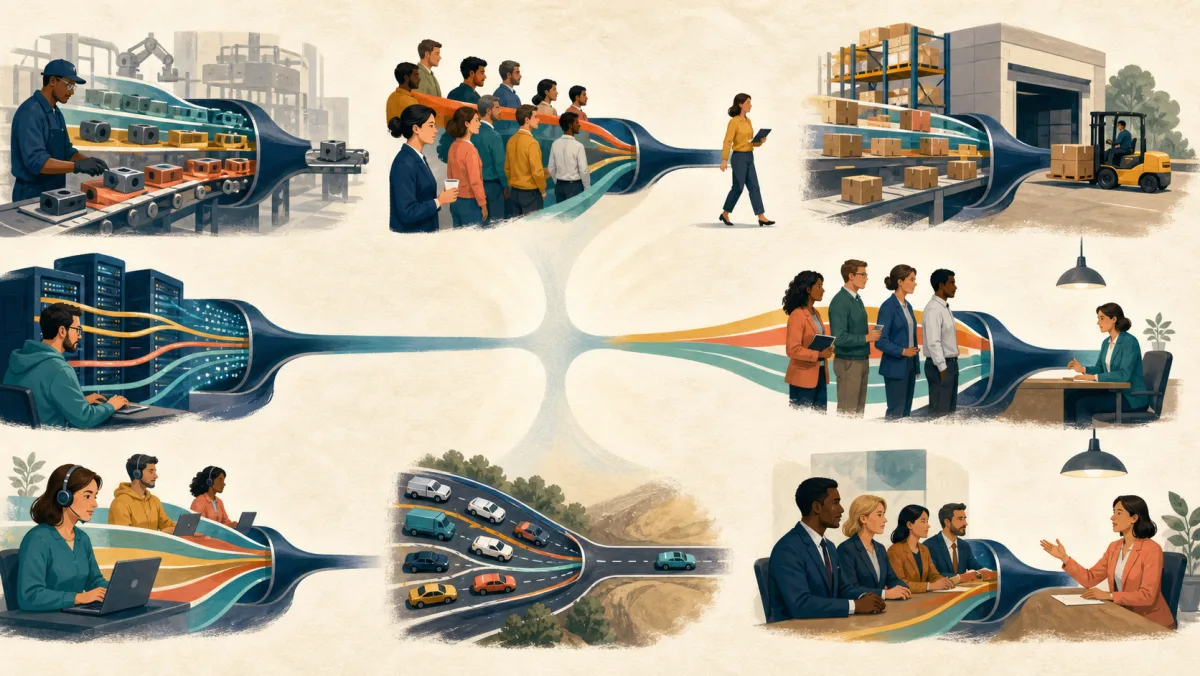
Bottleneck names a point that limits flow or capacity. It may be a step, resource, rule, or dependency. A process can have more than one bottleneck, and the main limit can change over time. These examples show several workplace uses.
Quick check: a limiting step or one late item?
Choose the sentence that makes a measured flow claim without overstatement.
Ready to go beyond the quiz on "Bottleneck"?
Take the full learning path: hear it in real workplace contexts, watch short explanations, learn its nuances and when to use it, then practice using it yourself.
Start learning for free →Now see if you can use it naturally yourself.
Try it yourself
You know how to use "Bottleneck," too.
Keep going with the full learning path — more workplace contexts, related expressions, and continued practice.
Continue with "Bottleneck" →There's more to "Bottleneck" than it seems.
You've got part of it, but the full learning path goes deeper into its nuances, workplace contexts, and when it sounds natural — then gives you practice using it yourself.
Learn "Bottleneck" in depth →Process/workflow
"We traced every delay back to one place: the bottleneck is the approval step, not the work itself."
Bottleneck in/at can name a stage. The sentence links delays to approval based on the team's tracing.
Technical/systems
"The database is the bottleneck — the front end could serve triple the traffic if queries weren't the limiting factor."
Capacity/resource, reframed away from a person
"The review depends so heavily on one person's sign-off that it's become a bottleneck, regardless of how fast anyone else works."
This sentence names a dependency on one sign-off. It avoids blaming the person without evidence about the cause.
Decision/approval
"Procurement sign-off is the real bottleneck in vendor onboarding — everything else moves in days, that step takes weeks."
Want to actually use "Bottleneck" naturally at work?
Understanding it is one thing. Practice its nuances, see how it works in real workplace situations, and use it yourself with feedback.
Start the "Bottleneck" learning path →Growth/scaling, executive register
"The real question for the board isn't headcount — it's what's actually bottlenecking our ability to scale support."
Here, bottlenecking is the verb. The question asks what currently limits growth.
Supply chain
"The bottleneck this quarter is a single component supplier — everything downstream, from assembly to shipping, is waiting on them."
Sales/customer funnel
"Lead volume isn't our problem; the bottleneck is qualification — reps can't get through the backlog fast enough to convert them."
Preposition variety
"The bottleneck to hitting our Q3 target is onboarding capacity, not demand."
Bottleneck to [outcome] links the limit to a result. In or at is often clearer for a process stage.
Status-update phrasing, without blame
"Flagging a bottleneck in the release process: QA is currently the limiting step, and it's affecting every team downstream."
Calibration against a one-off delay
"One missed handoff last week wasn't a bottleneck — it was a delay. The recurring bottleneck is still the legal review queue."
Practice scenarios
Practice using bottleneck in situations like:
- writing a status update that names a bottleneck without assigning blame to a person
- distinguishing a recurring bottleneck from a one-off delay
- describing a technical bottleneck to a non-technical stakeholder
- connecting a bottleneck to a specific business decision about where to invest next
Useful practice phrases:
- "The bottleneck is in [stage], and it's affecting everything downstream."
- "This step depends heavily on [person/system], which has made it a bottleneck."
- "That was a one-off delay, not a bottleneck — the recurring one is still [stage]."
- "What's bottlenecking [outcome]: [cause A] or [cause B]?"
Turn Harbor Clinic’s queue into one clear sentence
Each sentence names a proposed limiting point. Good analysis should test that claim with data and observe what changes after the limit is addressed.
Use bottleneck for a constraint on flow or capacity, not merely any problem. A short delay can still cause a temporary bottleneck, while a recurring delay may have several causes.
Lyra Practice helps advanced non-native English professionals learn the nuance of high-value workplace expressions and practice using them in realistic scenarios, so their English sounds natural, precise, and senior at work. Try Lyra Practice.