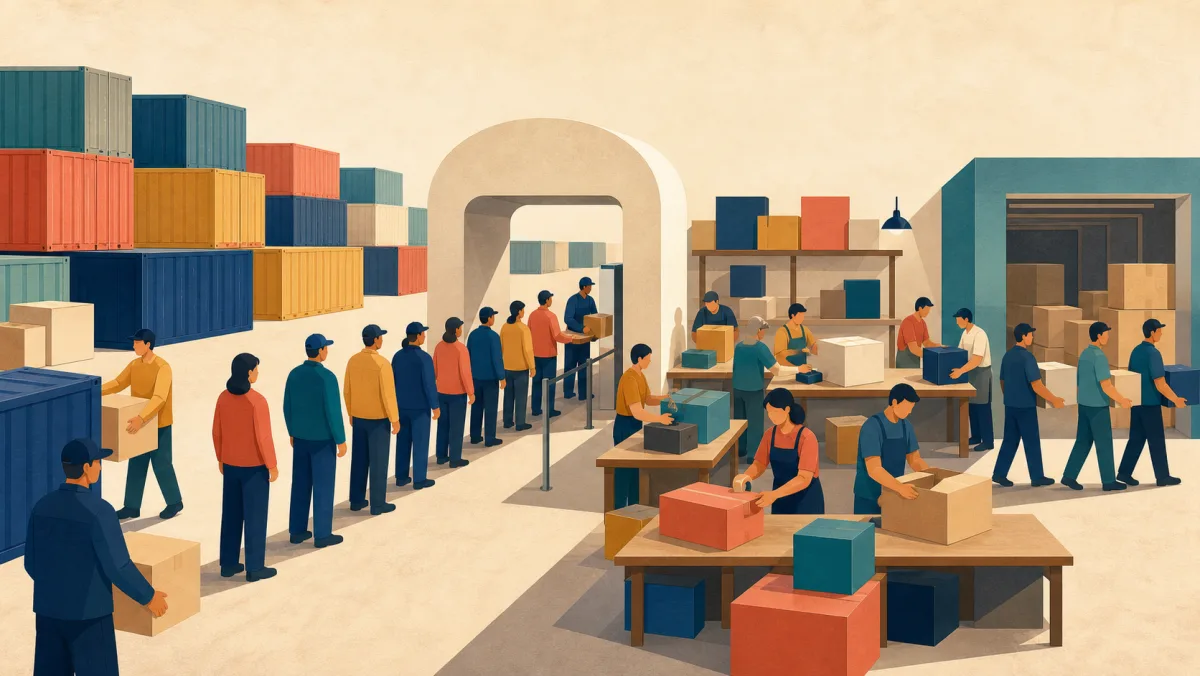
Bottleneck is common in supply chain talks. Use it for a point that limits the system's total flow.
That point might be customs, a port, a vendor, or packaging. A scarce part or limited storage space may also constrain flow. The label depends on evidence about capacity and output.
Quick check: scarce parts or a capped port gate?
Choose the point that currently limits total daily shipments.
Ready to go beyond the quiz on "Bottleneck"?
Take the full learning path: hear it in real workplace contexts, watch short explanations, learn its nuances and when to use it, then practice using it yourself.
Start learning for free →Now see if you can use it naturally yourself.
Try it yourself
You know how to use "Bottleneck," too.
Keep going with the full learning path — more workplace contexts, related expressions, and continued practice.
Continue with "Bottleneck" →There's more to "Bottleneck" than it seems.
You've got part of it, but the full learning path goes deeper into its nuances, workplace contexts, and when it sounds natural — then gives you practice using it yourself.
Learn "Bottleneck" in depth →A shortage and a bottleneck aren't automatically the same claim
A shortage means demand exceeds the available supply. A bottleneck is the point that limits total output. A shortage can create a bottleneck, but it may not do so.
"Customs clearance is the current bottleneck, not a general component shortage — the components exist, they're just stuck."
Here, the parts exist and are waiting for clearance. Customs is a bottleneck only if that delay limits later work. One delayed shipment alone does not prove that claim.
"A single vendor's production capacity is the bottleneck — orders within their normal run size move fine, but anything beyond it gets capped."
Here, the vendor may limit output when demand exceeds a stated volume. Check units per day, queue time, and demand. Normal orders moving well does not prove the vendor has spare capacity.
"The shortage is real, but the customs hold is the specific bottleneck production is waiting on right now."
Both claims may be true at the same time. Data should show which issue now limits production. The limiting point can also move when demand or capacity changes.
Want to actually use "Bottleneck" naturally at work?
Understanding it is one thing. Practice its nuances, see how it works in real workplace situations, and use it yourself with feedback.
Start the "Bottleneck" learning path →Common mistakes
Mistake: calling any shortage or delay a bottleneck without checking system flow.
Name the stage, the measure, and the effect. For example, report its daily capacity and current queue. Then state which later work is waiting. Rerouting, faster shipping, or new sourcing may help. Each option still needs cost, risk, and feasibility checks.
Practice scenarios
Practice describing a supply chain bottleneck in situations like:
- separating a general shortage from a measured limit on total flow
- explaining why output reaches a stated capacity at higher order volumes
- proposing a response tied to a named stage and supporting data
Useful practice phrases:
- "[Stage] is the current bottleneck: its capacity is [measure], while demand is [measure]."
- "[Vendor/stage] is limiting total output above [threshold], based on [data]."
- "The shortage is real, but [stage] now limits production because [evidence]."
Report Atlas Bikes’ packaging ceiling
"We're short on parts" identifies a supply problem.
"Customs now limits output to 500 units daily" identifies the stage called the "bottleneck."
Lyra Practice helps advanced non-native English professionals learn the nuance of high-value workplace expressions and practice using them in realistic scenarios, so their English sounds natural, precise, and senior at work. Try Lyra Practice.