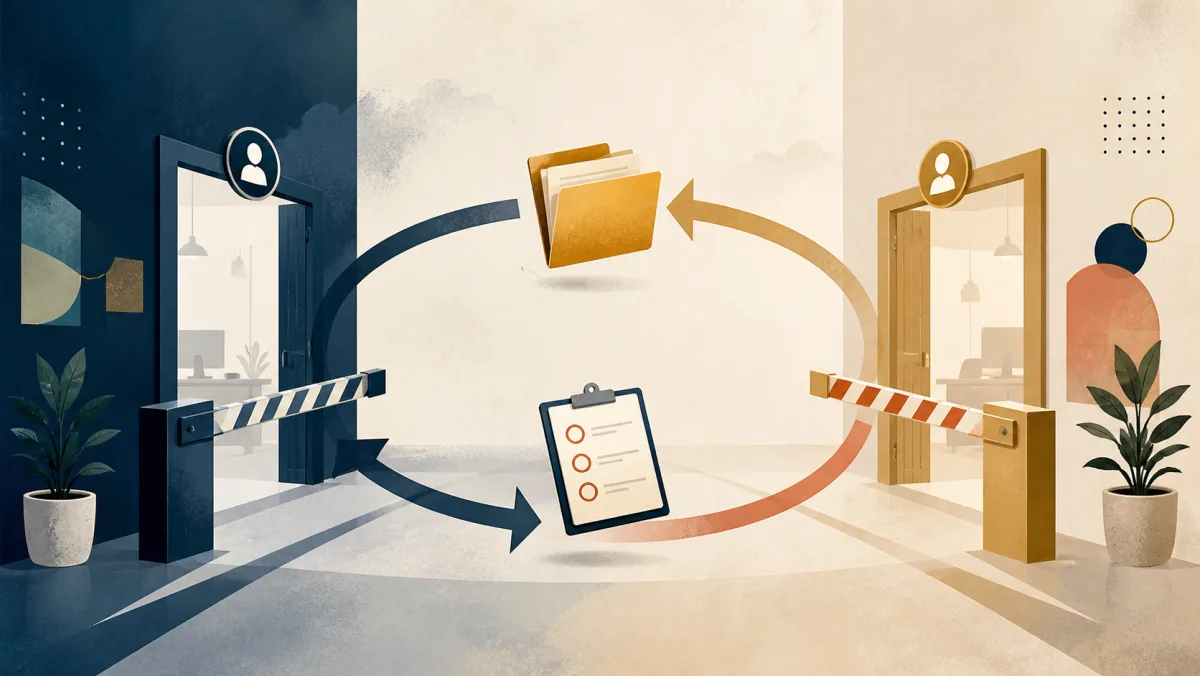
A catch-22 is a situation where one requirement cannot be met until another is met, but the second cannot be met until the first is met.
The examples below show the expression in realistic workplace contexts. They also show the grammar around it, not only the definition.
Want to get better at distinctions like this?
Lyra Practice helps you learn the nuance of high-value workplace expressions, then practice using them in realistic situations.
See how Lyra Practice works →Natural examples
Example 1
“We cannot test in production without access, but security will not grant access until we show production test results—a classic catch-22.”
Example 2
“Small suppliers face a catch-22: they need approved-vendor status to bid, but they need a completed contract to qualify.”
Example 3
“The policy creates a catch-22 for new hires who need system access to finish the required training.”
Example 4
“We are in a catch-22: audit needs system logs before granting access, but we need access to generate those logs.”
Example 5
“The policy has put new suppliers in a catch-22.”
Example 6
“We face a catch-22: training requires an employee account, while account activation requires completed training.”
Example 7
“We face a catch-22: customers want pilot results before sharing data, but the pilot cannot run without their data.”
Example 8
“We are in a catch-22 because access needs test evidence and testing needs access, so I propose a supervised evidence-collection session consistent with policy.”
More ways to build the sentence
These are the main patterns to practice:
be in a catch-22face a catch-22create a catch-22a classic catch-22avoid a catch-22
Use the pattern that matches your message. Do not force the expression into every sentence. A direct description is often better when the stakes are high or the audience may not know the phrase.
What the sentence needs to make clear
A strong sentence gives enough context for the listener to understand why the expression fits. Name the plan, behavior, decision, or result you mean. If the phrase contains criticism, connect it to observable facts rather than using it as a label.
Compare these nearby choices:
| Choice | What it adds |
|---|---|
| dilemma | a difficult choice between alternatives, without necessarily containing a circular dependency. |
| deadlock | a standstill because parties or processes cannot move forward. |
| bottleneck | a step whose limited capacity slows the whole flow. |
| paradox | an apparently contradictory statement or situation that may still be true. |
These terms may describe the same situation from different angles. Choose the one that matches the point you need to make.
Tone and audience
Catch-22 is common but somewhat informal and allusive. In technical, formal, or client-facing writing, circular dependency or a direct statement of the two blocked requirements may be clearer.
Before using the expression, ask three questions:
- Does the sentence match the expression's real meaning?
- Is the tone suitable for this person and setting?
- Would a plain description be clearer or fairer?
Practice it aloud
Start with one of the common patterns. Add a real but non-confidential workplace situation. Then say the sentence once in a direct version and once in a softer version. This helps you control both meaning and tone.
The goal is not to memorize one example. It is to build a sentence that makes the meaning, evidence, and tone clear.
Lyra Practice helps advanced non-native English professionals learn the nuance of high-value workplace expressions and practice using them in realistic scenarios, so their English sounds natural, precise, and senior at work. Try Lyra Practice.