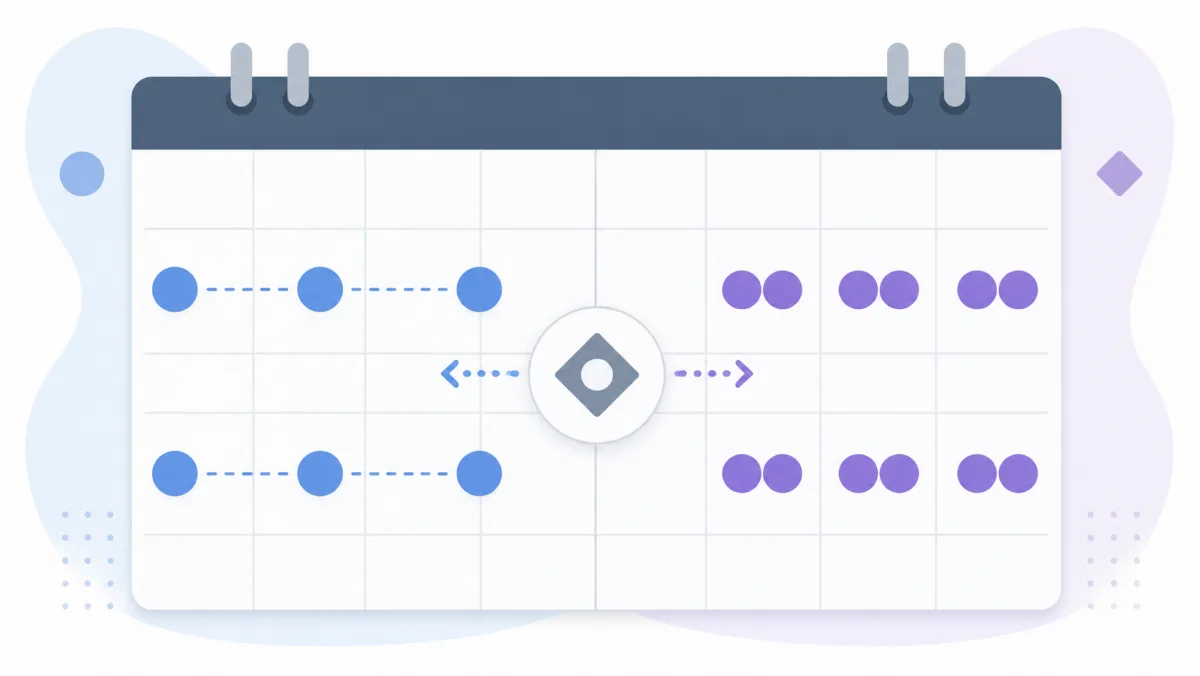
Biweekly has two accepted meanings: once every two weeks and twice a week. Major dictionaries record both senses. Context may suggest one meaning, but it cannot always settle the schedule.
“Let’s make this a biweekly meeting.”
This could mean fewer meetings than a weekly schedule, or twice as many. If work depends on the interval, ask for exact days or dates.
Why is biweekly ambiguous?
The prefix bi- expresses a relationship with two. In time words, speakers have applied that idea in two ways: two events within one period, or one event across two periods.
That produces both readings:
- twice a week: two meetings during each week;
- every two weeks: one meeting, then another 14 days later.
Some speakers strongly prefer one definition and consider the other incorrect. Both uses are established, however. At work, confirming the dates is more useful than debating which meaning should prevail.
What might you hear at work?
“Payroll is biweekly.”
In many U.S. workplaces, this means payment every two weeks. Still, an employee should check the employer's written pay schedule. The label alone does not establish the actual pay dates or annual number of payments.
“We need biweekly client check-ins.”
The frequency is unclear. Ask whether the client expects two calls each week or one call every other week. That answer can affect staffing and preparation time.
“The newsletter has a biweekly cadence.”
Cadence describes a recurring rhythm or schedule. It does not resolve the two meanings of biweekly.
“Can you send a biweekly report?”
The requester may care about delivery days, reporting periods, and time zones. The recurrence label answers none of those questions by itself.
A lot to take in? It is.
But Rome wasn't built in a day. Build your American workplace English one expression and cultural reference at a time—with curated explanations and structured practice in Lyra Practice.
Start a session →What can you say instead?
For one occurrence in each two-week period:
“Let’s meet every two weeks on Tuesday.”
“The report is due every other Friday.”
For two occurrences in each week:
“Let’s meet twice a week, on Tuesday and Thursday.”
“Please send updates two times per week.”
Weekday names remove another source of uncertainty. For more detail on these explicit forms, see every other week versus twice a week.
How can you clarify naturally?
You can ask for clarification without suggesting that the speaker made an error:
“By biweekly, do you mean every two weeks or twice a week?”
“Could we put the recurrence and first two dates in the invitation?”
“Just confirming: Tuesday and Thursday each week?”
“Just confirming: August 25, then September 8?”
Specific dates are valuable across countries. The date 09/08 may mean September 8 or 9 August, depending on local convention. Spell out the month or use a clear format approved by your organization.
Time zones and calendar invitations
Even a clear frequency can create different local times. “Every two weeks at 9:00” is incomplete for a distributed team. Name the time zone in planning text, then send a calendar invitation that displays the event locally.
“Every other Tuesday at 9:00 a.m. Eastern time, beginning August 25.”
Daylight-saving changes may shift the local time for colleagues elsewhere. Regions change clocks on different dates, and some do not change them. Calendar software can apply configured time-zone rules, but participants should review the displayed series.
Avoid relying on a manual conversion for a long series. A confirmation such as “This appears as 10:00 a.m. for me in São Paulo” can reveal a configuration error before the first meeting.
Biweekly, semiweekly, and bimonthly
Semiweekly means twice a week, but the word is uncommon enough to make some readers pause. Plain twice a week is clearer.
Bimonthly has a similar ambiguity. It can mean twice a month or every two months. If the schedule matters, state the dates or the explicit interval.
Fortnightly means every two weeks and is common in some varieties of English. Many Americans understand it, but every two weeks is usually clearer in a global workplace.
Recognition versus production
When you hear biweekly, remember both possible meanings. Do not silently choose the one most common in your country or company. When you write, prefer language with only one possible recurrence.
The stakes are higher in payroll, medication, staffing, compliance, customer commitments, and deadlines than in casual plans. For medication, follow the written directions and ask a pharmacist or prescriber if the timing is unclear. For pay, legal duties, or service terms, consult the controlling policy or contract and seek qualified advice when rights depend on the wording.
For ambiguous calendar language beyond recurring meetings, see which Friday “next Friday” means and business days versus calendar days.
The practical takeaway
Biweekly genuinely has two meanings. At work, replace it with every two weeks or twice a week. Add weekdays, start dates, and a time zone when they matter. A brief clarification is safer than an assumption.