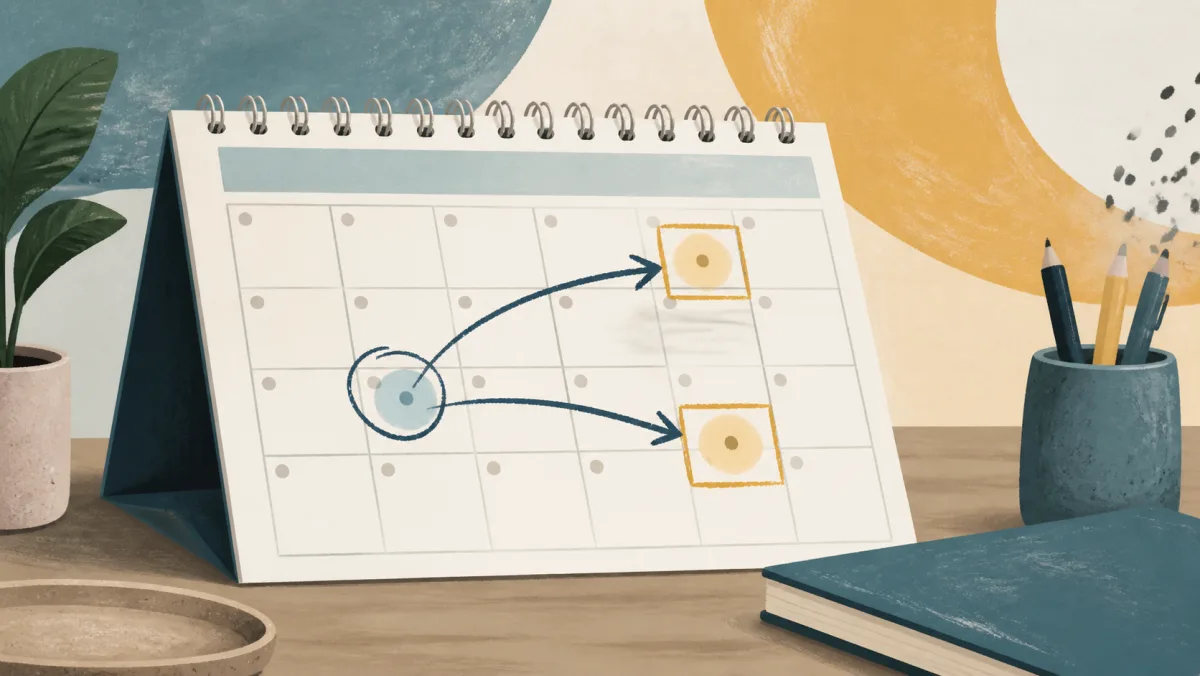
Next Friday may mean the coming Friday; it may also mean the Friday of the next calendar week. Speakers do not all follow one rule, and the day of the request can shape how they read it.
“Can we review this next Friday?”
If today is Monday, one person may mean the Friday four days away, while another may call that this Friday and mean the Friday 11 days away. A calendar date removes the need to debate the phrase.
Why does the phrase split interpretations?
Next can point to the first item after now or to an item in the next named period, as in next week. With weekday names, both readings are possible.
One person may reason:
The next Friday on the calendar is the coming Friday.
Another person may reason:
This week has “this Friday”; next Friday belongs to the next week.
Dictionaries record more than one time sense of next, so they cannot identify a speaker's intended date. Usage can vary across regions, families, and workplaces.
“This Friday” can also need confirmation
This Friday often means the Friday in the current week or the nearest one ahead, but the reference point may shift around the weekend. On Saturday, “this Friday” may mean the day before to one person and the coming Friday to another.
Other phrases can also cause doubt:
- coming Friday often means the next one ahead, but a listener may still check;
- Friday week varies by dialect, so it is a poor default for a global team;
- a week from Friday means seven days after a given Friday, but that first date must be clear.
The clearest solution is to give the date.
A lot to take in? It is.
But Rome wasn't built in a day. Build your American workplace English one expression and cultural reference at a time—with curated explanations and structured practice in Lyra Practice.
Start a session →What might you hear at work?
“The client wants the deck next Friday.”
Before you plan the work, confirm the exact date and, if needed, the time zone.
“I’m taking next Friday off.”
Your colleague is sharing availability, so a brief reply works: “Do you mean Friday the 14th?”
“Let’s move the meeting to this Friday.”
The calendar invite should show the date. Check it before you decline another meeting or change your plans.
“We can ship the following Friday.”
Following Friday needs a clear reference point. Ask which date or event comes first. The phrase may mean the Friday after a date already discussed.
What can you say naturally?
To check two possible dates:
“Do you mean Friday, September 4, 2026, or Friday, September 11, 2026?”
To propose a meeting:
“Could we meet on Friday, September 4, 2026, at 10:00 a.m. Eastern time?”
To confirm the agreed date:
“Confirmed for Friday the 4th. I’ll send the calendar invite now.”
To avoid guessing at a deadline:
“You mentioned next Friday. Which date should I add to the plan?”
Use the date your group agreed on; these dates only show a clear format.
Date-writing traps
Dates written only with numbers can create a new problem. In common U.S. use, 9/10 often means September 10. In many countries, it means 9 October.
Write the month as a word:
“Friday, September 10”
An ISO-style date, 2026-09-10, puts the year first, then the month and day; this format works well in many technical systems. Follow your organization's standard, and label formats that readers may not know.
Check that the weekday matches the date, since calendar software may flag a mismatch but plain email may not. If someone writes “Friday, September 10” for a Thursday, ask whether the weekday or date is right.
Time zones can change the weekday
A late Friday meeting in California may fall on Saturday for a colleague in Asia. The phrase “Friday midnight” is risky because it may mean the start or end of Friday and may omit the time zone.
Use a full deadline instead:
“Due by 5:00 p.m. Pacific time on Friday, September 4, 2026.”
Check how a calendar event appears in each person's local zone; when people work in different places, include the source time zone in the event notes.
Daylight-saving changes can alter the gap between time zones. A weekly call may stay at 9:00 a.m. in New York, while its local time shifts for colleagues in places that change clocks on other dates or not at all.
Recognition versus production
When you hear next Friday, keep both common dates in mind and look for clues such as this week, next week, or an earlier date. For an important promise, confirm rather than guess.
When you speak, adding a date is useful, natural, and helpful for both native and non-native speakers. In a quick chat, “Friday the 14th?” is often enough.
Do not assume that a different reading means your colleague was careless, since many speakers use the phrase in different ways. Focus on a shared date, not on winning a language debate.
For other relative deadlines, see later today and by tomorrow. For rough time spans, see what “a couple of days” means.
The practical takeaway
“Next Friday” does not name one certain date for every speaker, so confirm it by writing the month. Add a time and zone when they matter, and check that the weekday and date agree. The goal is a shared schedule, not a ruling on which reading is correct.