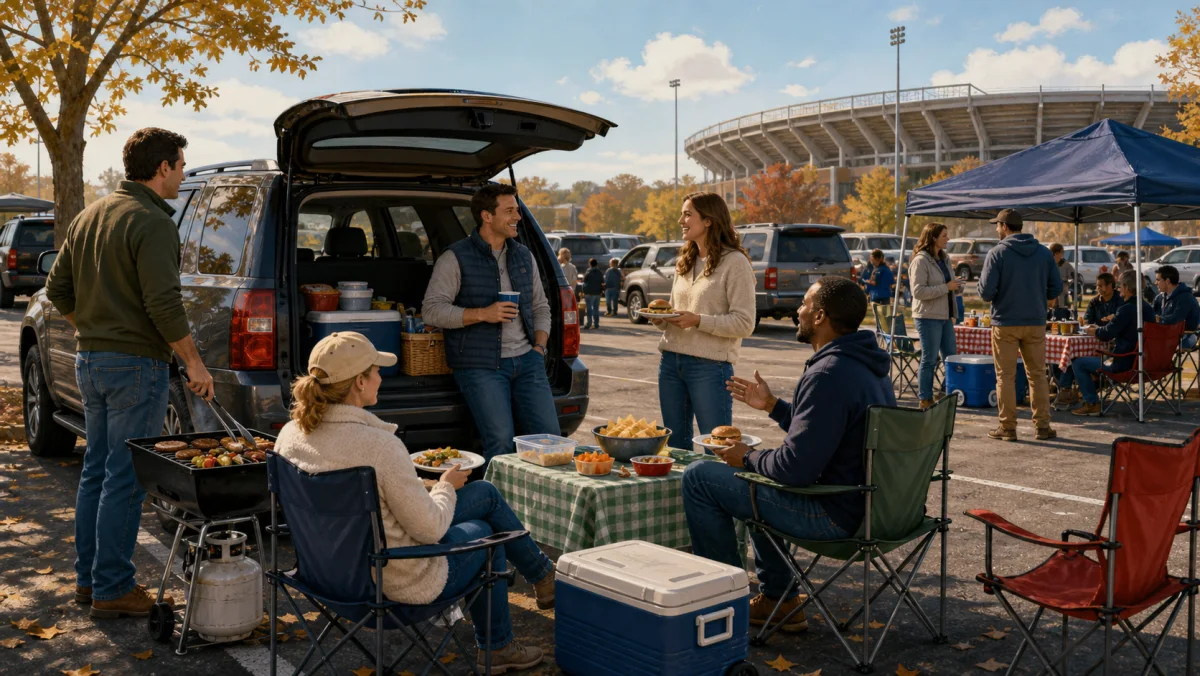
Before a U.S. sports game, tailgating means gathering near the venue to socialize. People often meet in a parking lot to eat or play games. The word refers to a vehicle's rear tailgate, but modern events may use cars, tents, grills, and tables.
A company may host a tailgate for workers or clients. Coworkers may also arrange one on their own. The invitation is to a social event linked to the game.
The word also has traffic and security meanings. Context tells you which one applies.
What happens at a tailgate?
People may arrive hours before a football game. Tailgates also occur before baseball, racing, concerts, and other events. Guests may grill, share snacks, play outdoor games, wear team colors, and talk with fans.
Practices vary by venue, region, weather, and sport. Some events are small family gatherings. Others have company sponsors, catering, and reserved space. Venue rules may limit grills, glass, alcohol, tents, or entry times.
You might hear:
"We're tailgating in Lot C before the game."
"The company tailgate starts at noon, and kickoff is at four."
Kickoff is the start of a football game. Here, the social event begins well before play.
"Are you going to the game or just the tailgate?"
You may not need a game ticket, but check the parking and venue rules.
What should you bring?
Ask the host. A company event may provide food and drinks. For an informal gathering, guests may bring a chair, food, ice, or soft drinks.
You could say:
"Thanks for inviting me. Should I bring anything?"
"Is food provided, or is this more like a potluck?"
"Do I need a game ticket to enter the tailgate area?"
Useful items may include water, sunscreen, good shoes, and clothes for the weather. Access needs also vary. Parking surfaces, distance, seating, noise, crowds, and restrooms may matter. Ask the host or venue for specific details.
If coworkers are sharing food, the guide to American workplace potlucks includes useful language for contributions and dietary needs.
A lot to take in? It is.
But Rome wasn't built in a day. Build your American workplace English one expression and cultural reference at a time—with curated explanations and structured practice in Lyra Practice.
Start a session →Alcohol and participation
Many tailgates offer alcohol, but some do not. You do not have to drink. Venue rules and local laws apply. People may avoid alcohol for health, faith, recovery, driving, pregnancy, sport, or personal reasons.
A simple response is enough:
"No thanks—I'm good with water."
"I'm driving, so I'll stick with soda."
Nobody owes a reason. Hosts should label alcoholic and alcohol-free drinks and avoid pressure. Plan a safe ride, and never drive while impaired.
Riskier:
"You can't really tailgate unless you're drinking."
Safer:
"There will be plenty of food and nonalcoholic drinks too."
For a related work social setting, see whether an American workplace happy hour is really optional.
How might tailgating come up at work?
Coworkers may discuss their weekend plans:
"We're heading to the stadium early to tailgate."
They may also use a game as a client or team event:
"Sales is hosting a customer tailgate before Sunday's game."
If clients attend or the event appears on a work schedule, ask about expectations:
"Is the customer tailgate part of the event schedule, or is it optional?"
"What time should the client-facing team arrive?"
An informal invitation might sound like:
"A few of us are tailgating Saturday if you'd like to come."
You could accept with:
"I'd like to join. I've never been to a tailgate—where should I meet you?"
Or decline with:
"Thanks for thinking of me. I can't make it this weekend, but I hope you have a good game."
Safe ways to join the sports conversation
You do not need deep sports knowledge. Ask a simple question:
"Is tailgating a regular tradition for this group?"
"Who is the team playing today?"
"What's the game everyone is playing with the beanbags?"
The last question may refer to cornhole. Players toss small bags toward a raised board with a hole. Its name and popularity vary by region.
Do not treat sports fans as representatives of all Americans. Many people do not follow sports. Some fans care more about the social event than the result.
Do not confuse the three meanings
In traffic, tailgating means following another vehicle too closely:
"The driver behind me was tailgating me on the highway."
At a sports venue, it means the social gathering:
"We were tailgating outside the stadium."
In building security, tailgating can mean an unauthorized person following someone through a controlled door:
"The security team reminded us not to let anyone tailgate through the badge entrance."
Listen for clues such as highway, parking lot, kickoff, badge, door, and game.
The sports tradition has no single format. Ask about time, tickets, food, weather, access, and expectations. Join only at the level that works for you.
To follow the game itself, read American football rules for non-Americans or baseball rules for non-Americans.