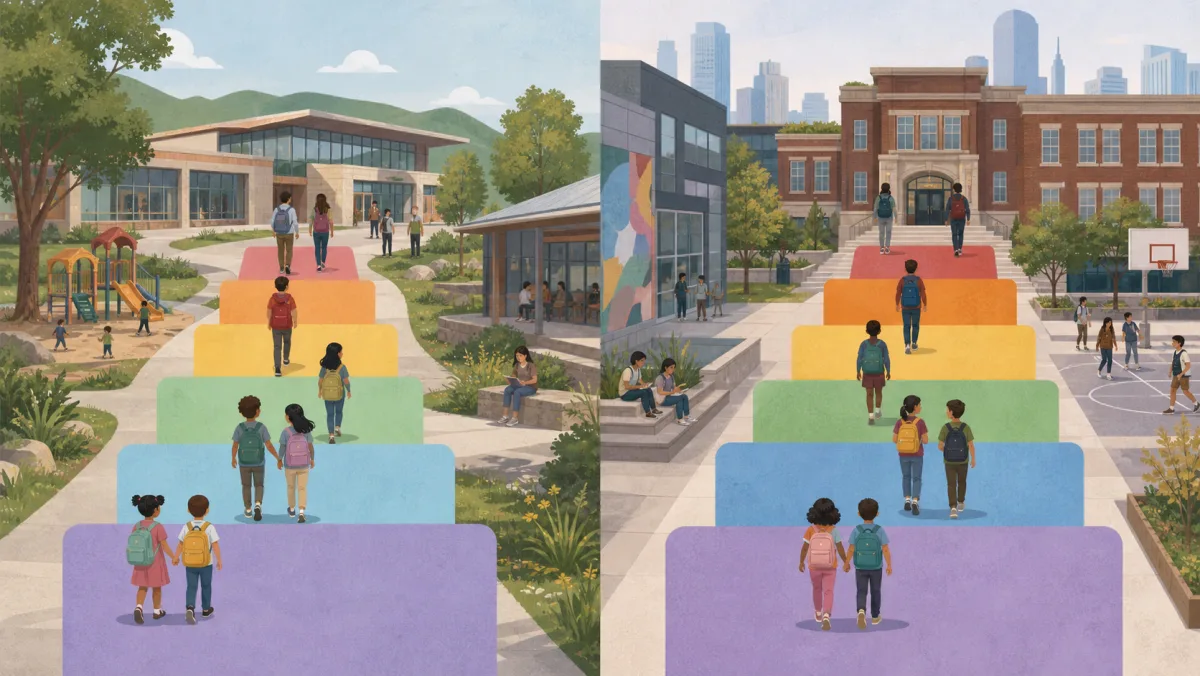
Middle school and junior high both name the stage before high school. In American English, middle school is often the broader label, but both terms remain in use. The exact grades depend on the school or district.
"My son starts middle school next year."
The child is probably around grades 6–8, but the phrase does not prove an exact grade or age.
What grades are in middle school?
A familiar U.S. arrangement is:
- elementary school: kindergarten through grade 5
- middle school: grades 6–8
- high school: grades 9–12
This is only one common arrangement. A middle school may use another local span, such as grades 5–8, 6–7, 6–8, or 7–8. For data reporting, NCES defines its middle-school category as at least three grades. The category usually ends with grade 8 or 9. Local school names may follow other rules.
You may also hear intermediate school for this stage, and its grade span also varies.
What grades are in junior high?
Junior high school often covers grades 7–8 or 7–9. Traditionally, its structure may be closer to high school. Some districts still use the name officially:
"Lincoln Junior High"
Elsewhere, people use junior high for the same ages as middle school.
School names and structures differ. Ask “Which grades?” instead of correcting the label.
Is there an educational difference?
Educators have sometimes treated the names as different models. Junior high may extend a subject-based high school model downward. Middle school may focus more on early adolescent development. It may use teaching teams or work across subjects.
This distinction is not reliable in every school. A junior high may use middle school features. A middle school may organize classes by subject. The name alone does not describe the full student experience.
At work, both terms usually mean school between elementary and high school.
A lot to take in? It is.
But Rome wasn't built in a day. Build your American workplace English one expression and cultural reference at a time—with curated explanations and structured practice in Lyra Practice.
Start a session →What might you hear at work?
"The junior high has a teacher conference day on Friday."
The colleague is likely explaining a change to the child's schedule.
"Middle-school pickup is earlier than high-school pickup."
This may affect the colleague's availability for meetings.
"I have not seen her since junior high."
Here, junior high means a period in the speaker's youth. It does not describe the current school system.
"That joke belongs in middle school."
This figurative use calls something immature. It can sound insulting, especially when aimed at a colleague.
"Our interns are helping with a middle-school STEM event."
This means an educational activity for that age group.
What can you say naturally?
For scheduling:
"I have a middle-school parent conference at 3:30, so I will join the client call from home."
For small talk:
"Is she in middle school already? Which grade?"
For your background:
"I moved to the United States during junior high, around seventh grade."
If you are communicating to an international audience, you can add the grade range:
"The program serves middle-school students in grades 6 through 8."
The grade range helps international readers understand the term.
Recognition versus production
Both names point to the same general stage. Do not infer an exact age, curriculum, or school quality.
For policies or benefits, ask for exact records. Do not rely only on the school label:
"The policy covers grades 1 through 8. Does that include the student's current program?"
This avoids confusion from different local definitions.
Avoid status and maturity judgments
School talk can become sensitive. People may compare districts, scores, neighborhoods, or school types. A neutral response is:
"I hope the transition goes smoothly."
Do not assume a school name signals quality or family income. Also avoid using middle school as an insult for team conflict:
Riskier:
"This discussion is so middle school."
Clearer:
"The discussion has become personal. Can we return to the decision criteria?"
For the stage before this one, see elementary school versus primary school. For the following grades, see freshman, sophomore, junior, and senior in high school.