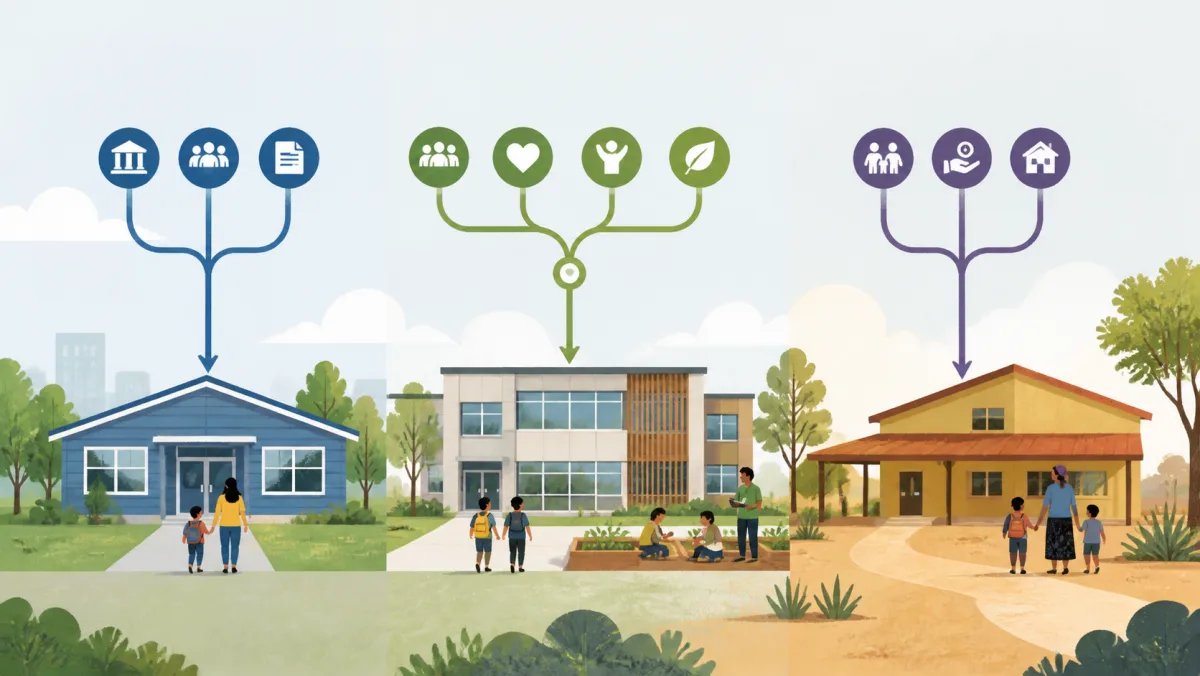
In the United States, a public school belongs to the public system, while a private school sits outside it. At the K–12 level, funding, control, and rules help define each group. State school is less precise and depends on context.
This differs from British use, where public school can name certain fee-charging private schools.
What is a U.S. public school?
At the K–12 level, public school means a school mainly supported by public funds. Eligible students generally attend without tuition, but assignment and choice rules vary.
NCES definitions use public support and public-system status. Public schools include district, charter, magnet, and other types. Charter schools are public, though some have private managers.
"Our children attend the local public school."
A US listener will often understand this as a school in the public system.
What is a private school?
A private school sits outside the public-school system and may be religious or nonsectarian. Tuition is common, but funding, aid, and entry rules vary.
"She went to a private high school."
This names the school type, not how good, selective, religious, or costly it is.
Some private schools use the label independent school. Its exact meaning varies by school and association.
What does “state school” mean?
In US higher education, state school often means a public college or university supported by a state:
"I went to a state school and paid in-state tuition."
The speaker likely attended a public school in the state system, where in-state tuition depends on residency rules.
At the K–12 level, Americans usually say public school, not state school. Historically, state school has also named some state-run residential or correctional institutions. It is therefore not a simple synonym in every context.
If a colleague says state school, ask which education level they mean.
Public and private at the university level
US colleges and universities can also be public or private. A public university belongs to a public system, while a private university has independent control. Both may charge tuition, and either may be selective.
Do not assume that public university means free because tuition, fees, residency rules, and aid vary widely.
A lot to take in? It is.
But Rome wasn't built in a day. Build your American workplace English one expression and cultural reference at a time—with curated explanations and structured practice in Lyra Practice.
Start a session →What might you hear at work?
"The relocation benefit covers private-school tuition abroad."
This is policy language. The benefit may have limits, eligibility rules, or exclusions.
"School is closed for a district professional-development day."
This likely refers to the local public-school district. Private schools may also close for staff training.
"I chose a state school because it offered a strong engineering program."
The speaker means a public college or university. The phrase says nothing certain about selectivity.
"Our product serves both public and private K–12 schools."
This separates market groups by school type.
"Did you go to public school?"
The speaker may mean K–12 education. The question can touch on family money and social background.
What can you say naturally?
For parental scheduling:
"The public schools are closed tomorrow, so I will work from home."
For your background:
"I attended a public university in my home country."
For benefits clarification:
"Does the education allowance cover tuition at any accredited school, or only specific private schools?"
For an international comparison:
"When I say public school, I mean a government-funded school, not the British use of the term."
Recognition versus production
When an American says public school, first think of the public system. When someone says state school, higher education may be the clue. Ask if the level matters:
"Do you mean a public university?"
On a résumé, use the school's official name. You rarely need to label it public or private unless that fact matters.
Avoid class and quality assumptions
School type can connect with neighborhood, faith, family money, entry, and social status. Those links vary and can be sensitive.
Avoid treating one category as a shortcut for quality or intelligence:
Riskier:
"She sounds private-school educated."
More useful:
"She has experience presenting to executive audiences."
In hiring, assess job-related skills and follow relevant rules. Do not use school type as a shortcut for prestige.
For grade-level vocabulary, see U.S. school levels from pre-K through graduate school. For institution terms, see college versus university versus graduate school.